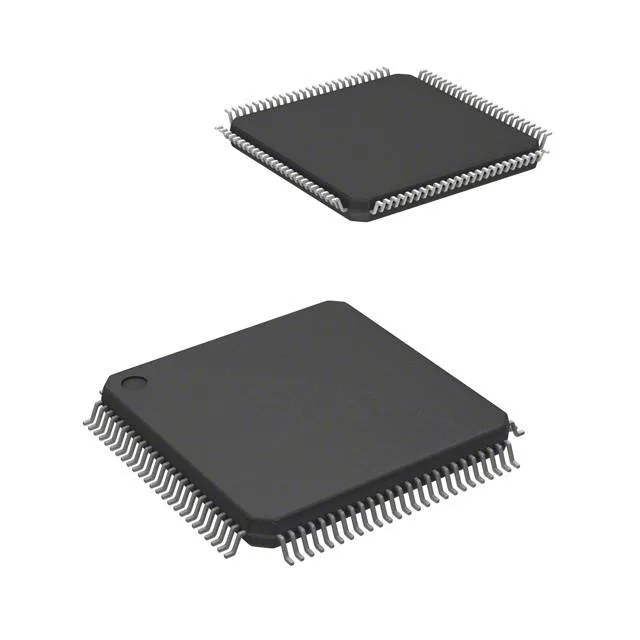
Active STM32F100VBT6BTR — value-line ARM Cortex-M3 with 128 KB Flash
It is built for cost-sensitive industrial control, sensor hubs, motor-drive interfaces, and general embedded systems where the peripheral set — DMA, PDR, POR, PVD, PWM, temp sensor, and watchdog — covers the common housekeeping tasks without a separate supervisor IC.
24 MHz core speed — what it covers and where it sits
The 24 MHz clock is the STM32F100 value-line ceiling, not the STM32F103 performance tier. That is fine for a UART-to-SPI bridge, a PWM fan controller, a CAN gateway running at 125 kbps, or a temperature-logger polling a sensor every 100 ms. If your application needs floating-point or a 72 MHz bus for a display frame buffer, this part is not the fit — but for the majority of 8-bit upgrades and low-bandwidth control loops, 24 MHz with zero-wait-state Flash access is enough headroom.
128 KB Flash and 8K x 8 RAM — firmware and data budget
128 KB of Flash is the mid-density option in the STM32F100 line. A typical FreeRTOS application with a TCP/IP stack and a command-line interface fits in about 60 KB to 80 KB, leaving room for a bootloader and OTA staging. The 8K x 8 SRAM is tight — budget 4 KB for the stack and heap, 2 KB for DMA buffers, and the rest for global variables. If your design queues Ethernet frames or stores a large lookup table, the RAM will be the constraint before Flash.
Industrial temperature grade and on-chip peripherals
The integrated DMA, POR, PVD, and windowed watchdog reduce external BOM count — no separate reset supervisor or brown-out detector needed.
Package and footprint: 100-LQFP (14x14)
The 100-LQFP with 0.5 mm pitch and a 14x14 mm body is a common footprint for 4-layer boards. The exposed pad is not present on this package variant, so thermal dissipation is through the leads — keep the ambient airflow or derate if the part runs continuous PWM at 85°C.