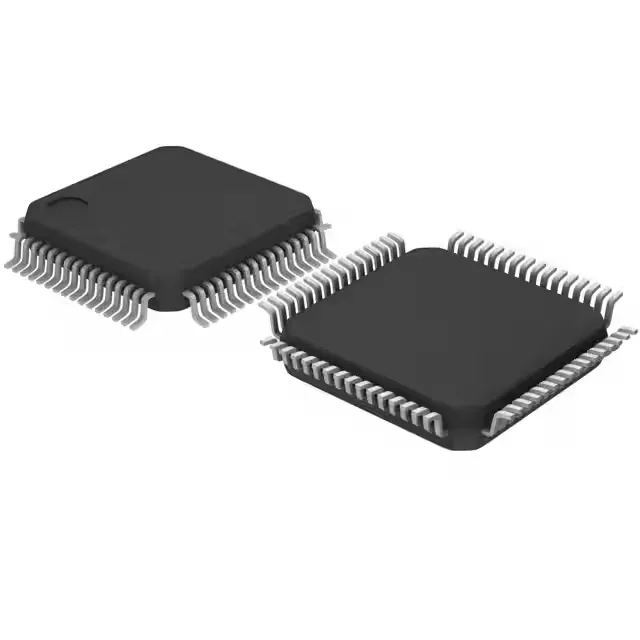
The part targets cost-sensitive embedded control applications where the Cortex-M0 core provides adequate throughput for motor control, sensor fusion, and human-machine interfaces without the power or cost premium of a Cortex-M3 or M4. The 48 MHz clock rate is the practical ceiling for this core — firmware that needs tight loop timing or fast peripheral response should budget for the 1-cycle flash wait state at that speed. The 256 KB Flash is generous for the STM32F0 family, leaving room for a bootloader, application code, and a small OTA staging area. With 52 I/O lines and a rich peripheral set including CANbus, I²C, SPI, and multiple UART/USART channels, this MCU can serve as the central controller in a distributed control node or gateway.
Industrial temperature grade and environment
The 105°C upper limit provides margin above the typical 85°C industrial ceiling, which matters when the MCU sits near a power stage or in a sealed enclosure with limited airflow.
Peripheral integration: CANbus and analog converters
The STM32F091RCT7 includes a CANbus interface (supporting CAN 2.0B), which is a key differentiator versus many Cortex-M0 parts that omit CAN. The ADC can sample multiple channels in sequence without CPU intervention using the DMA controller, freeing the core for higher-level tasks.