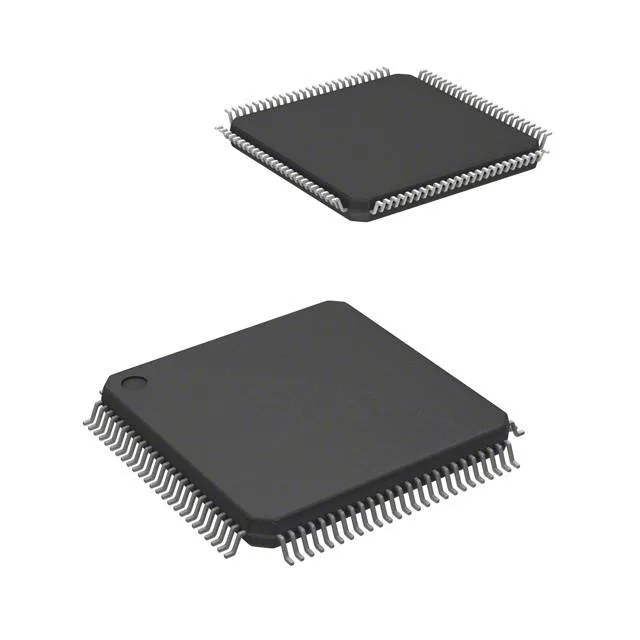
48 MHz Cortex-M0 — entry-level 32-bit with deterministic timing
The STM32F072VBT6: It is built for cost-sensitive control applications — motor commutation, sensor fusion, USB-C power delivery, and CAN-bridged industrial nodes — where the M0's two-cycle interrupt latency and single-cycle I/O access keep the firmware tight. The 100-LQFP package (14x14 mm) exposes 87 I/Os, enough to interface with a parallel LCD, a keypad matrix, and a dozen sensors without an external GPIO expander.
The 128 KB Flash (128K x 8) is the mid-density option in the STM32F0 line, suitable for a bootloader plus a full application layer.
Peripherals and connectivity — CAN, USB, and dual DAC on a single chip
This MCU integrates a CAN 2.0B controller, a USB 2.0 full-speed device (with crystal-less operation), HDMI-CEC, I²C, SPI, USART/UART with IrDA and LIN support, and an I²S audio interface. The 12-bit ADC samples 16 external channels at up to 1 Msps; the dual 12-bit DAC outputs can generate two independent analog control voltages for external MOSFET bias or sensor excitation.
ST lists the STM32F072VBT6 as an active product. For a new design starting today, there is no lifecycle-driven reason to qualify a second source.