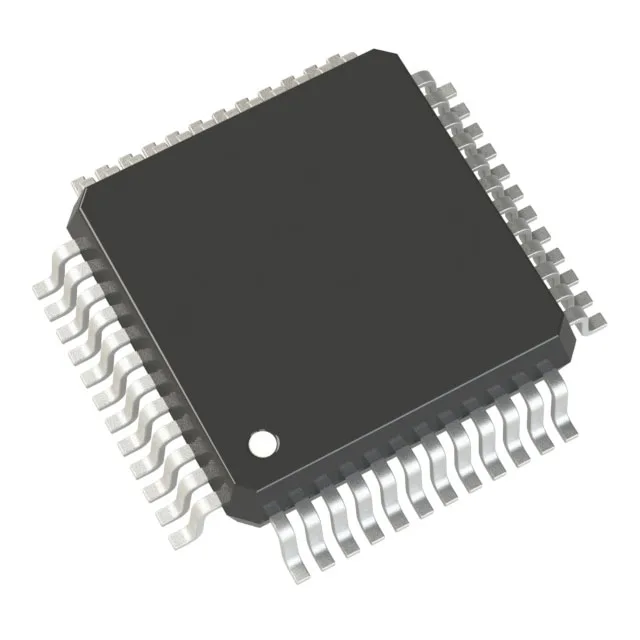
48 MHz Cortex-M0 with 64 KB Flash — what this MCU does on the BOM
Memory and peripheral fit — sizing the firmware and the board
That's enough code space for a USB stack, a CANopen node, or a basic motor-control loop, but firmware teams should budget the 64 KB early — a full RTOS with USB composite device class can push past 50 KB. The 37 GPIOs in the 48-LQFP package leave room for a parallel LCD data bus or a handful of sensors and actuators without needing an external port expander. The integrated 12-bit ADC with 10 channels and the 12-bit DAC with 2 channels cover most low-speed analog acquisition and output needs. If the application requires more than 10 analog inputs or higher resolution, an external ADC or a larger STM32F3/F4 part would be the next step up.
USB and CAN on a single MCU — interface integration note
The STM32F072C8T6 includes a USB 2.0 full-speed device controller and a CAN 2.0B controller — unusual for a sub-$3 Cortex-M0 part. The USB peripheral handles DFU, HID, and CDC classes without an external PHY; the CAN controller needs an external transceiver (like a TJA1050 or SN65HVD230). Both interfaces share the same 48 MHz clock, so the PLL must be configured to hit the exact 48 MHz for USB bit timing — the internal oscillator is factory-trimmed but a 16 MHz external crystal is recommended for USB compliance.
Package, temperature, and assembly
The 1.65 V minimum supply voltage allows the MCU to run from a single alkaline or lithium cell down to near-depletion, making it a candidate for battery-powered handhelds and wireless sensor nodes where the voltage rail sags under load.
ST continues to manufacture the STM32F0 series, and this part is widely available through the independent distribution channel.