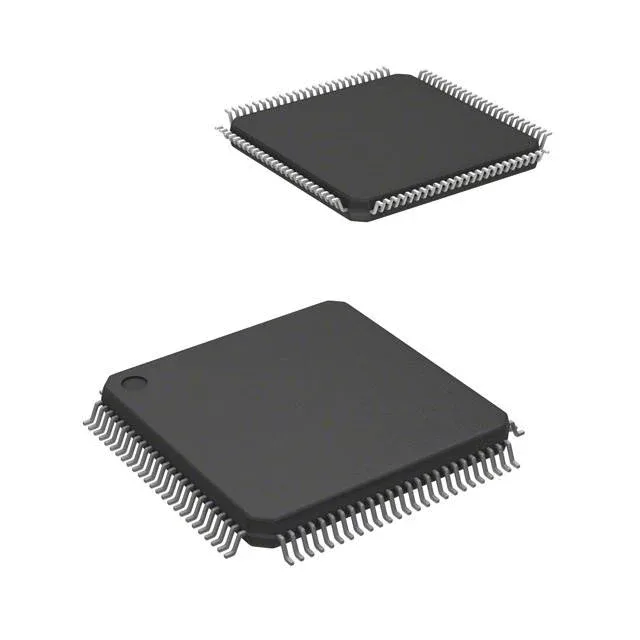
48 MHz Cortex-M0 — what the speed tells you
The STM32F071VBT6 runs an ARM Cortex-M0 core at 48 MHz. That clock ceiling places it in the value-line tier of the STM32F0 family — it handles sensor fusion, motor commutation loops, and protocol bridging, but it is not built for heavy DSP or high-frame-rate graphics. The 48 MHz PLL requires a flash wait state adjustment if you step the core clock past 24 MHz; the bootloader handles the default, but firmware that cranks the system clock early needs to set the latency register or it will fault on the first instruction fetch from flash.
With 128 KB of program flash and 16 KB of SRAM, this part fits applications running a lightweight RTOS (FreeRTOS or similar), a USB stack, and moderate data buffers. The 16 KB RAM is the binding constraint for packet buffering in I²C or SPI bridges — a 4 KB Ethernet or CAN frame buffer would consume a quarter of it. The flash endurance is rated for the STM32F0 standard 10k program/erase cycles; wear-leveling in the application layer matters if you store configuration parameters in the same sector as code.
Analog integration — 19-channel ADC and dual DAC
The STM32F071VBT6 packs a 12-bit ADC with 19 multiplexed channels and two 12-bit DAC outputs. That peripheral density is uncommon at this price point — it eliminates an external ADC for multi-sensor acquisition and a separate DAC for analog set-point generation. The ADC conversion rate tops out near 1 Msps; the DAC settles in a few microseconds. If your BOM currently carries a separate 12-bit ADC and a single DAC, this MCU absorbs both, saving board area and supply-chain line items.
Connectivity — I²C, SPI, USART, LIN, IrDA, HDMI-CEC
The peripheral set covers the common industrial and consumer serial buses: multiple I²C and SPI ports for sensor and display links, USART with LIN support for automotive body networks, and IrDA for cordless data links. The HDMI-CEC interface is a niche addition — it lets the MCU act as a CEC controller in HDMI source/sink products without an external translator. No CAN controller is on die; if your application needs a CAN bus, you will add an external SPI-to-CAN transceiver or step up to the STM32F1 or STM32F3 series.
Lifecycle — active, no obsolescence risk
STMicroelectronics lists the STM32F071VBT6 as Active product status. There is no NRND notice, no last-time-buy window, and no announced EOL.