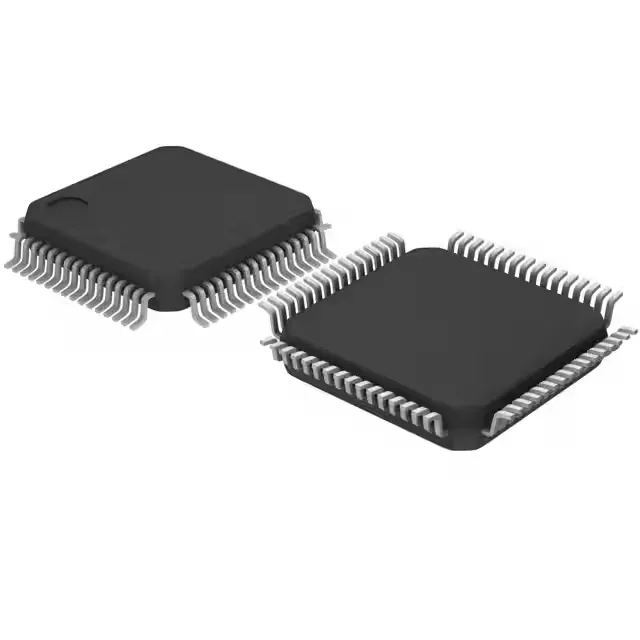
This is the kind of MCU you reach for when you need a balanced mix of processing power, analog integration, and peripheral count in a cost-sensitive design — think motor drives, sensor hubs, or industrial control panels.
48 MHz Cortex-M0 — enough for real-time control
The 48 MHz core clock is a practical sweet spot for control-loop applications. It's fast enough to handle a field-oriented motor control loop with sensor feedback, or to poll a bank of sensors over SPI while maintaining a responsive UI. The Cortex-M0 is a single-cycle 32-bit core, so arithmetic and bit-manipulation operations don't stall the pipeline the way an 8-bit core would. If your firmware needs to run a PID loop at a few kilohertz or process a serial stream at 1 Mbps, this part has the headroom — and the Flash wait states are handled automatically by the STM32F0's prefetch buffer, so you don't need to tune them manually.
128 KB of Flash is enough for a moderate-complexity application — a bootloader, a real-time operating system kernel, a communication stack (say, Modbus RTU over UART), and a few thousand lines of application code. The 16 KB of RAM (organized as 16K x 8) will hold a couple of 1 KB data buffers, a small stack, and the global variables for a typical control application. If your design leans heavily on DMA transfers or needs large frame buffers, you'll want to budget the RAM carefully — but for most sensor-fusion or actuator-control tasks, it's adequate. The Flash is rated for the usual STM32 endurance (10,000 write/erase cycles), so field-update wear is not a concern for typical product lifetimes.
On-chip analog — ADC and DAC reduce external parts
The 19-channel 12-bit ADC covers a lot of analog inputs — enough to monitor multiple sensor voltages, a potentiometer, and a current-sense resistor without an external multiplexer. The two 12-bit DACs can generate analog setpoints or bias voltages, which is handy for trimming a reference or driving an analog actuator. Just keep the analog supply pin clean — a ferrite bead and a 100 nF cap on the VDDA pin is the usual practice.
Connectivity and peripherals — what's on the bus
That's a broad set: I²C for sensor buses and EEPROMs, SPI for high-speed ADCs or displays, UART for RS-232 or RS-485 transceivers, and LINbus for automotive body networks. The HDMI-CEC interface is a niche addition — useful if the MCU is controlling a TV or set-top box. The DMA controller can offload data transfers on any of these peripherals, which frees the CPU for control tasks.
No need to chase broker inventory or worry about date-code restrictions.
Package and footprint — 64-LQFP, 10x10 mm
The 51 I/O lines give you plenty of headroom for external peripherals — you can wire up a parallel LCD, a keypad matrix, a few sensors, and still have pins left for debugging. The surface-mount package is MSL 3 (moisture sensitivity level 3), so if the sealed bag has been open for more than 168 hours, bake the parts at 125°C for 24 hours before reflow. For high-current I/O, keep the total package current below the absolute maximum rating (typically 80 mA total for the VDD/VSS pair).