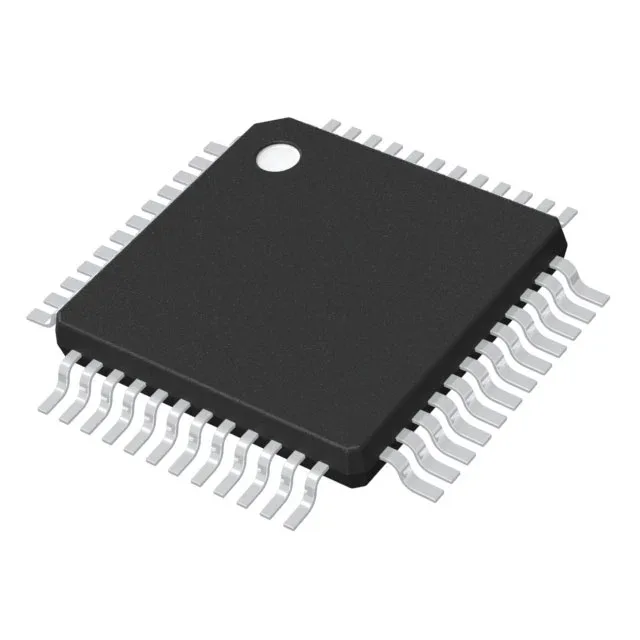
48 MHz Cortex-M0 with 128 KB Flash — entry-level workhorse
It is aimed at cost-sensitive control and sensor-fusion tasks in industrial and consumer equipment — motor drives, user interfaces, IoT node controllers, and communication bridges. The Cortex-M0 core keeps power draw low while the 48 MHz clock provides enough headroom for real-time control loops and moderate protocol stacks (e.g., Modbus RTU, CANopen via external transceiver). The 37 available I/O in a 48-LQFP package gives enough pins for a small keypad, a character LCD, and a few external peripherals without needing a port expander.
Industrial temperature and supply — where it fits
The 1.65 V minimum lets it run from a pair of alkaline cells near end-of-life, while the 3.6 V maximum covers a 3.3 V rail with margin. If you need the full industrial temperature range and the I/O count, this is the baseline STM32F0 option — no AEC-Q100 qualification here, so for automotive cabin use you would step to the STM32F0A or STM32F1 automotive-grade siblings.
Peripheral set: analog and serial interfaces
On the digital side it packs I²C, SPI, USART, and LINbus — plus HDMI-CEC for consumer-remote control and IrDA for short-range optical links. The DMA controller offloads peripheral-to-memory transfers without stalling the core, which matters when you are streaming ADC samples or driving a PWM waveform at the same time. Internal oscillator means no external crystal for many applications, saving two pins and some BOM cost.
The 48-LQFP (7×7 mm) is a common, hand-solderable package with a 0.5 mm pitch.
If you are dual-sourcing, the STM32F071 series shares the same base die as the STM32F051 — the main difference is the expanded analog (DAC) and connectivity (HDMI-CEC) on the 071 — but the pinout and SWD debug interface are consistent across the 48-pin LQFP variants in this family.