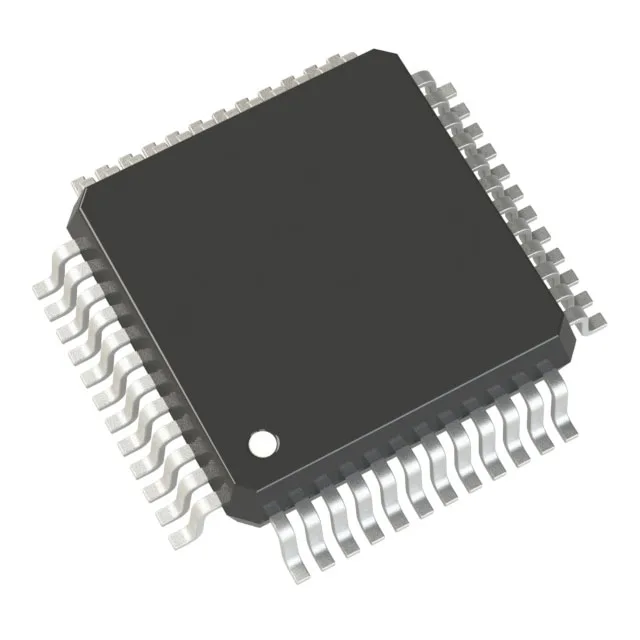
48 MHz Cortex-M0 with USB — entry-level workhorse
The 48-LQFP (7x7 mm) package gives you 37 general-purpose I/O and a 13-channel 12-bit ADC.
The 128 KB program memory is sized for a modest application stack — a USB CDC class driver, a few sensor drivers, and a simple control loop fit comfortably. The 16 KB SRAM is the tighter resource: a USB buffer consumes about 1 KB per endpoint pair, and a modest RTOS kernel takes another 2–4 KB, leaving 10–12 KB for application data. If your design needs a GUI framebuffer or large DMA buffers, the RAM budget will be the first constraint you hit.
USB 2.0 full-speed device — the differentiator
The USB peripheral is the headline feature on this F0 variant. It supports control, bulk, interrupt, and isochronous transfers, with a dedicated 48 MHz clock from the internal oscillator — no external crystal required for USB operation. This makes the STM32F070CBT6TR a natural fit for USB-CDC virtual COM ports, HID-class devices (keyboards, mice, gamepads), and DFU-based firmware updates. The STM32Cube firmware package includes ready-to-port USB device class examples.
The wide supply range lets you run directly from a 3.3 V rail, a 2.5 V logic supply, or a single Li-ion cell down to 2.4 V. The internal POR and brown-out reset handle startup sequencing, so the BOM stays lean — no external supervisor needed for most designs. At 48 MHz the typical active current is in the 20–30 mA range; stop-mode current drops below 5 µA with the RTC running.
It is ROHS3 compliant.