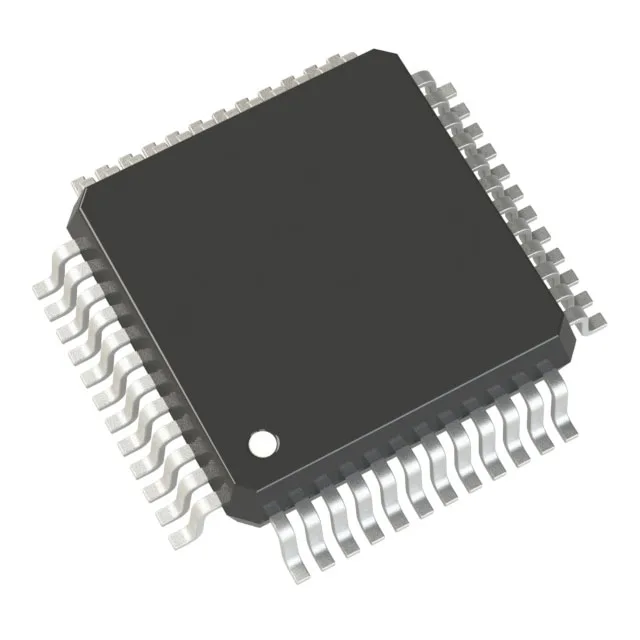
What the STM32F070CBT6 brings to the BOM
On-chip peripherals include DMA, a POR/BOR reset controller, PWM timers, and a watchdog timer, plus a 12-channel 12-bit ADC for analog sensor inputs.
It is fully ROHS3 compliant, so it passes European and global environmental regulations without an exemption letter. The base product number STM32F070 covers the whole family, making it straightforward to order the exact Flash/RAM/package variant without cross-referencing multiple datasheets.
48 MHz Cortex-M0 — enough for USB and sensor fusion
The ARM Cortex-M0 core at 48 MHz delivers around 0.9 DMIPS/MHz, or roughly 43 DMIPS total. That is modest by today's standards, but it is sufficient for polling a dozen sensors, driving a small TFT over SPI, and handling USB control transfers without a dedicated co-processor. The 16 KB SRAM limits buffering — plan for DMA-driven transfers rather than large frame buffers. If USB is used, the internal 48 MHz RC oscillator is trimmed to meet USB jitter requirements, though a crystal is still recommended for high-throughput isochronous endpoints.
USB, I²C, SPI, UART — connectivity for a control node
The STM32F070CBT6 includes one USB 2.0 full-speed device controller, two I²C interfaces (one supporting SMBus), two SPI ports (up to 18 Mbit/s), and up to four UART/USART modules. This peripheral set lets a single MCU handle a sensor bus (I²C), a display or radio (SPI), a debug/console UART, and a USB link to a host PC or charger. The 37 I/O pins are 5 V tolerant on most ports, which simplifies level-shifting when interfacing with legacy 5 V logic or industrial sensors. The 12-channel 12-bit ADC samples at up to 1 µs conversion time, adequate for reading potentiometers, thermistors, or current-sense resistors in a control loop.