48 MHz Cortex-M0 — enough for most USB device tasks
The 48 MHz core speed is the standard ceiling for the STM32F0 value line. At this clock, the Cortex-M0 delivers around 0.95 DMIPS/MHz, which is sufficient for polling USB bulk endpoints, managing a small display, or running a PID control loop. The 6 KB SRAM is tight — budget about 1.5 KB for the USB buffer and stack, leaving roughly 4.5 KB for application data. Designs that need more headroom should look at the STM32F072 series with 16 KB RAM.
USB 2.0 device — no external PHY needed
The integrated USB 2.0 device controller supports full-speed (12 Mbps) operation with an internal PHY. It requires only a 1.5 kΩ pull-up on the D+ line and a series resistor on each data line. The USB peripheral shares pins with other I/O, so the design must allocate the USB pins before assigning the remaining 37 I/O. No external oscillator is needed — the internal RC oscillator can be trimmed to meet USB clock accuracy, though a 48 MHz crystal is recommended for tighter timing.
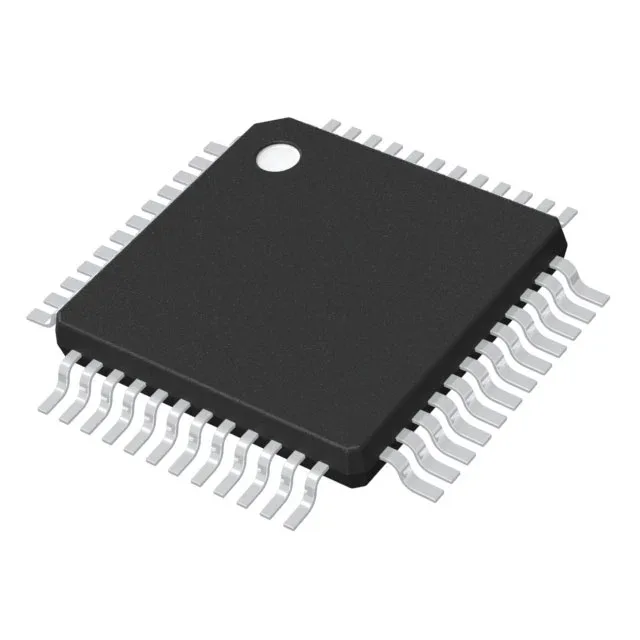
48-LQFP package — standard footprint for hand-assembly and reflow
The exposed pad is not present on this package variant, so thermal dissipation relies on the lead frame. For prototyping, the Cut Tape (CT) option is available; production runs typically order the Tape & Reel (TR) variant.