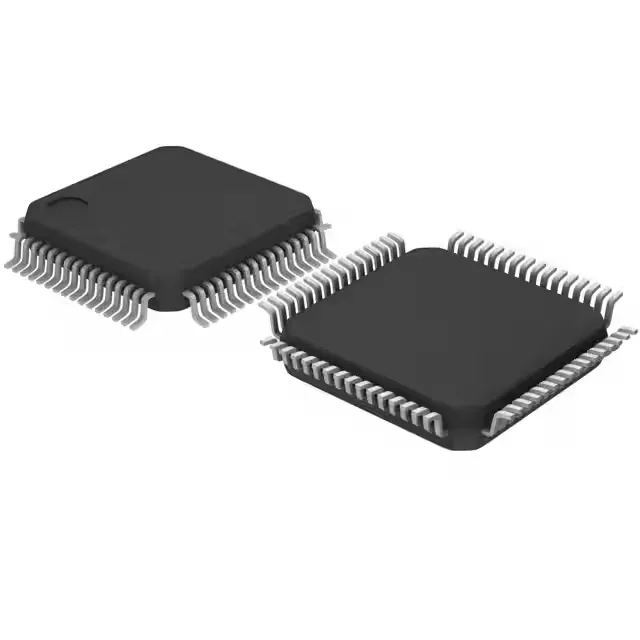
It packs 16KB of Flash and 8K x 8 of RAM into a 64-LQFP package — enough for sensor fusion, motor control loops, or communication bridges in industrial and consumer gear.
48MHz ceiling and 16KB floor — sizing the firmware
At 48MHz the Cortex-M0 delivers about 0.9 DMIPS/MHz, so you are looking at roughly 43 DMIPS peak. That is enough for a UART-driven protocol stack, a PID loop at a few kHz, or a basic UI over SPI. The 16KB Flash is the real limiter — you will want to compile with size optimization from day one and keep the bootloader lean. 8KB of RAM handles a couple of moderate buffers plus stack, but forget about large frame buffers or heavy data logging on chip. If your firmware outgrows the Flash, the STM32F051R6T6 (32KB) is the natural step up in the same package.
Industrial temperature, 64-LQFP — field-swap friendly
The 64-LQFP (10x10 mm) is a standard gull-wing package you can hand-solder with a decent iron and flux — no hot-air station required, no hidden pads underneath. That matters when you are swapping a dead MCU on site without a rework bench.
Supply range and on-chip converters
Operates from 2V to 3.6V, so it plays nicely with a single 3.3V rail or a 3.0V lithium cell.
No last-time-buy clock ticking, no forced redesign for a drop-in replacement. That gives procurement breathing room for multi-year production runs.