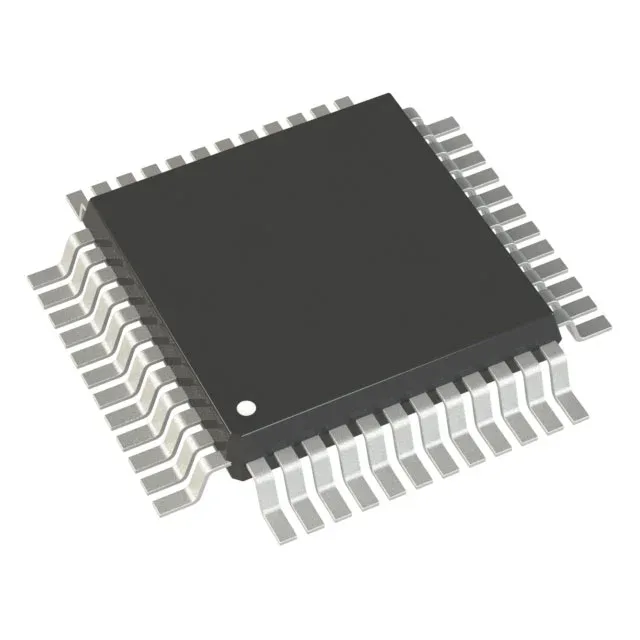
Entry-level 32-bit MCU with balanced analog and digital integration
Connectivity covers I2C, SPI, UART/USART, IrDA, LINbus, and HDMI-CEC.
The 64 KB Flash (64K x 8) and 8K x 8 RAM set the boundary for firmware complexity. A typical bootloader plus application image with a small RTOS fits comfortably; the 8 KB SRAM handles a few hundred bytes of stack plus moderate data arrays.
48 MHz Cortex-M0 — what the core speed delivers
At 48 MHz the Cortex-M0 delivers roughly 0.95 DMIPS/MHz, or about 45 DMIPS total. That is enough for polling loops, simple PID control loops at a few kHz, or UART/I2C protocol handling. It will not run heavy DSP or floating-point math — those go to Cortex-M4 parts. The internal oscillator trims to 1% accuracy, so an external crystal is optional for non-timing-critical links.
ST continues to manufacture this part, and no last-time-buy or end-of-life notice has been issued. For production planning, this means no forced redesign for at least the next several years. The part is ROHS3 compliant.
Tape & Reel variant — what the TR suffix signals
The base part STM32F051K8T6 (tray) is the same silicon and footprint; the TR suffix only changes the shipping medium. If your line uses tray feeders, order the T6 suffix version instead.