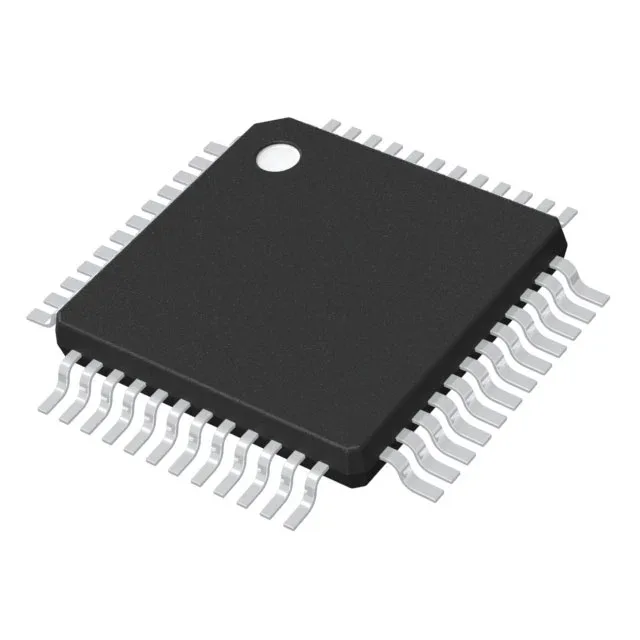
What this Cortex-M0 brings to the bench
The STM32F051C8T6TR is a 48 MHz ARM Cortex-M0 MCU from ST's STM32F0 value line, packing 64 KB of Flash and 8K x 8 of SRAM in a 48-LQFP package. It is the kind of part you reach for when a project needs a capable 32-bit core without the cost or complexity of a Cortex-M3 or M4 — think motor control with its built-in PWM, sensor fusion over I²C or SPI, or a simple HMI with the 13-channel 12-bit ADC and one 12-bit DAC on chip.
At 48 MHz the Cortex-M0 executes most single-cycle instructions, giving you roughly 48 MIPS of deterministic throughput. That is enough for a UART polled at 115200 baud, a 10 kHz PID loop, or a 1 ms task scheduler with a handful of peripherals. If your application needs to bit-bang a protocol or run a tight control loop, the 48 MHz ceiling sets the interrupt latency floor — the M0's two-cycle vector fetch means you can service an ADC interrupt in under 100 ns. The internal oscillator means you can skip an external crystal for cost-sensitive builds, though the accuracy (±1% typical over temp) may not hold a CAN bus or USB full-speed frame without external timing.
64 KB Flash and 8K RAM — sizing the firmware footprint
64 KB of Flash is the mid-density option in the STM32F051 line. It fits a bootloader plus a modest application — a Modbus slave stack, a few PID loops, and a UART command parser — without squeezing. The 8K x 8 SRAM (8 KB) is tight if you are buffering large ADC arrays or running a TCP/IP stack; for control and sensor-fusion work it is usually enough.
Peripheral set — what is on the bus
This MCU includes DMA, I²S, POR, PWM, and WDT. The 13-channel 12-bit ADC samples at 1 Msps, and the single 12-bit DAC can generate analog setpoints or audio tones without an external converter.
Supply voltage and power-up sequence
The supply range is 2.0 V to 3.6 V, covering 3.3 V and 2.5 V rails. It includes a power-on reset (POR) so you do not need an external supervisor for the basic startup sequence. The internal oscillator starts up in a few microseconds, so the MCU is executing code before most external regulators have settled. If you are running from a battery, the stop-mode current is typically a few microamps — enough for a coin-cell-backed RTC or wake-on-interrupt application.
That is the green light for new designs and production ramps — no last-time-buy scramble, no broker premium.