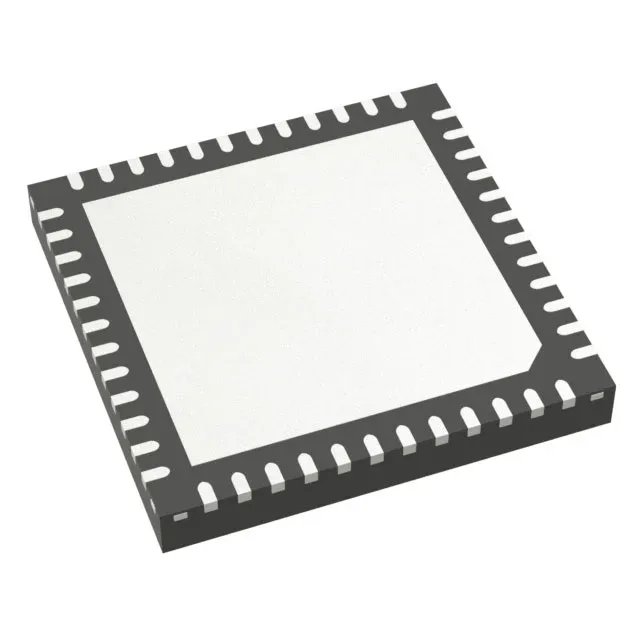
The STM32F051C6U6: It is built for cost-sensitive, real-time control applications — think motor commutation loops, sensor fusion, or communication bridges — where the Cortex-M0 delivers a balance of processing throughput and low gate count. The 39 GPIOs, combined with peripherals including I2C, SPI, USART, and a 12-bit ADC (13 channels), make it a natural fit for industrial sensor nodes, appliance control boards, and portable instrumentation. The supply range of 2.0 V to 3.6 V lets it run from a single Li-ion cell or a regulated 3.3 V rail without a secondary converter.
The 48 MHz core speed is the headline performance spec. For a Cortex-M0, that is enough to run a field-oriented control loop on a small BLDC motor, service a UART, or poll a dozen digital sensors in a sub-millisecond cycle.
Memory sizing for firmware and data buffers
The 8 KB SRAM limits the size of DMA buffers and stack depth; if your application needs a large frame buffer or a multi-kilobyte lookup table, you will want to step up to the 64 KB Flash / 16 KB RAM variants in the same package (STM32F051C8). The 8-bit-by-8-KB organisation means byte-wide access is native, but 16-bit or 32-bit loads are still single-cycle from SRAM.
Industrial temperature rating — where it goes
It is the standard offering on STM32F0 parts.
The STM32F0 series is a mature, volume-driven platform with broad distribution support, so supply continuity is stable.
Package and mounting — layout checklist
The pad is electrically connected to VSS on the die, so the PCB ground plane should have a solid copper pour under the part. The 0.5 mm pitch on the perimeter pads calls for a solder-mask-defined pad with a 0.25 mm aperture — standard for QFN assembly.