48 MHz ARM Cortex-M0 — the value-line workhorse
With 13 channels of 12-bit ADC on board, you can sample a handful of analog inputs without an external mux, which keeps the BOM tight for cost-sensitive industrial and consumer boards.
Connectivity that punches above its price tier
This part includes a USB 2.0 full-speed device controller with an integrated PHY — no external transceiver needed — plus a CANbus interface and HDMI-CEC. That combination is unusual at the 32 KB Flash level and makes the STM32F042K6T6 a natural fit for set-top boxes, smart remote controls, display interface boards, and IoT gateway nodes that need to bridge USB to CAN or I²C. The 26 GPIOs in the 32-LQFP package leave enough headroom for a small keypad, a few LEDs, and an external serial flash if the 32 KB program space gets tight.
Industrial temperature, active lifecycle, RoHS3
It carries ROHS3 compliance, so it passes the EU material restriction directive without an exemption.
32-LQFP footprint — manual assembly and rework friendly
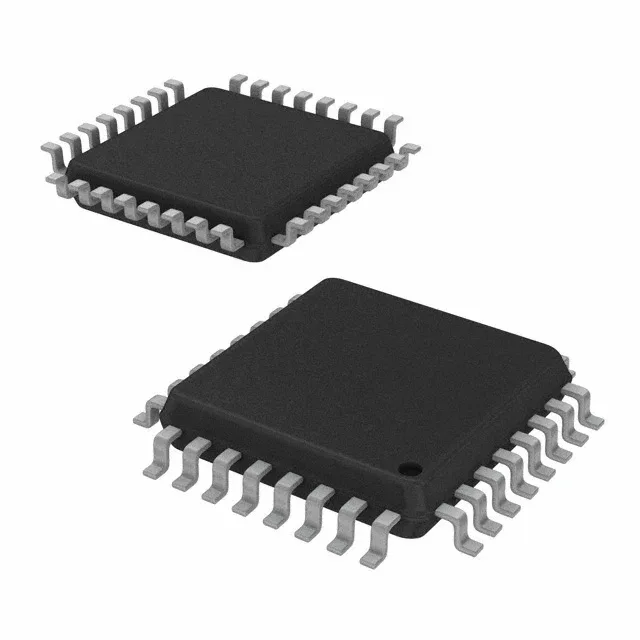
The 32-LQFP package with a 7x7 mm body and 0.8 mm pitch is a standard low-profile quad flat pack. No hidden balls, no via-in-pad requirement — just a straightforward footprint that matches the 32-LQFP land pattern in any PCB layout tool.
What this MCU is not — and why that matters for sourcing
This is a Cortex-M0, not an M3 or M4. The 48 MHz ceiling and 6 KB SRAM mean it will not run a real-time OS with a TCP/IP stack and a GUI — the memory just is not there. If your design needs more than a few kilobytes of heap or a second UART, the STM32F042K6T6 is the wrong starting point. But for a dedicated control task — a USB-to-CAN dongle, a single-zone thermostat, a battery monitor that samples one voltage and sends it over I²C — the 48 MHz core is overkill, not under. The comparison with the STM32L151CBU6A (Cortex-M3, 32 MHz, larger SRAM, more I/O) is a class jump: the series targets ultra-low-power battery applications with a richer peripheral set, but at a higher unit cost. The STM32F042K6T6 stays in the value tier where the BOM dollar buys the connectivity, not the core.
Sourcing this line — what the procurement desk needs
The shipping medium is Tray, which is the standard for 32-LQFP devices; no reel or tape fees apply unless a reeled variant is requested separately.