The 48 MHz core speed is the ceiling for this part; at that frequency the Flash requires one wait state for zero-wait execution below 24 MHz. For control loops — say, a BLDC commutation routine or a PID update at 10 kHz — the Cortex-M0's 32-bit data path and single-cycle multiply keep the loop tight without needing a DMA-assisted pipeline. Plan the firmware around that ceiling.
The 32 KB program memory (32K x 8) is enough for a bootloader, a modest RTOS kernel, and application code for a single-function controller — a thermostat, a fan-speed driver, or a CAN-to-UART gateway. The 4 KB RAM (4K x 8) handles a few hundred bytes of stack, a couple of 256-byte UART buffers, and a small data table. If your application needs over-the-air firmware updates, the Flash must hold both the active image and the staging area, so budget 8–12 KB for the OTA partition. The 13-channel 12-bit ADC can sample up to 13 analog inputs without an external mux, saving board space.
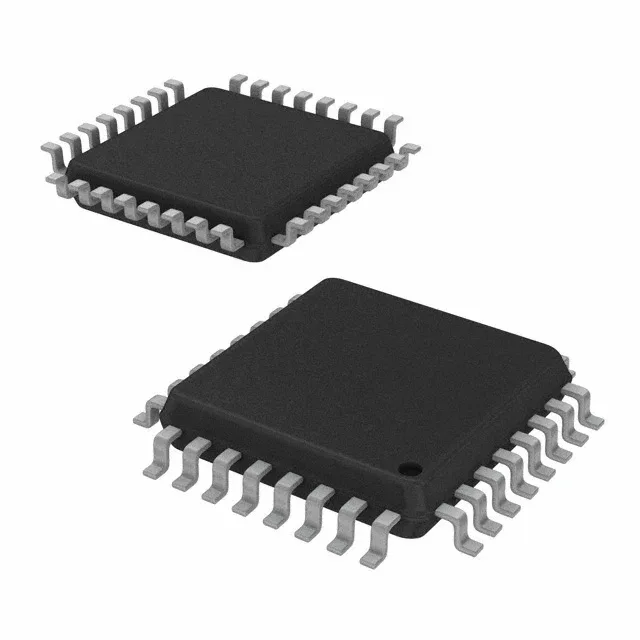
Package and footprint — 32-LQFP (7x7 mm)
The 25 I/O lines include up to 13 ADC inputs and the full set of serial peripherals.