256 KB Flash — the density tier that matters
At 256 KB, this is the largest Flash option in the STM32F030 family. That headroom lets you run a real-time OS, a USB stack, or a modest OTA update buffer without squeezing code into overlays. The 32 KB RAM handles moderate data arrays and communication buffers; if your application needs more than that for frame buffers or large lookup tables, you will want to step up to the STM32F1 or F4 series.
The 48 MHz core speed is typical for the Cortex-M0 class — enough for 100 kHz control loops, UART baud rates up to 3 Mbps, and SPI clocking at 12 MHz. It is not a number-cruncher; if you need DSP or floating-point, this core does not have it. But for digital I/O, ADC sampling, and protocol bridging, the 48 MHz clock keeps the bus responsive without the power draw of a faster core.
It is not qualified for under-hood automotive (no AEC-Q100 in the record) or extended-temperature downhole tools.
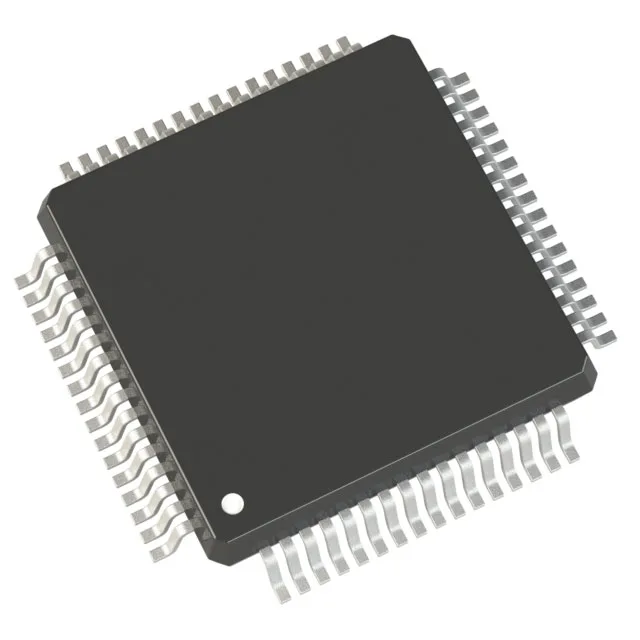
Housed in a 64-LQFP with a 10x10 mm body and 0.5 mm pitch, this is a hand-solderable, inspectable package. No hidden thermal pad — the LQFP dissipates through the leads, so keep the ambient airflow reasonable above 70°C.