Active production, 256 KB Flash, 32 KB RAM — what this MCU delivers
It is a current-production, active device — no last-time-buy risk for new designs.
Memory sizing — 256 KB Flash, 32 KB RAM
The 256 KB Flash (256K x 8) and 32 KB RAM (32K x 8) place this MCU in the mid-range of the STM32F0 series. For a typical firmware image — a bootloader, RTOS kernel, application code, and a modest data buffer — 256 KB gives comfortable headroom. The 32 KB RAM handles a few kilobytes of stack and heap plus a couple of moderate-sized DMA buffers. If your application needs more than 32 KB of runtime memory, you will need to look at the STM32F1 or STM32F4 families with larger SRAM options.
The ARM Cortex-M0 core runs at 48 MHz, which is the maximum for this part. At that speed, single-cycle multiply and a two-stage pipeline deliver roughly 0.9 DMIPS/MHz. For a control loop sampling at 10 kHz, you have about 4800 core cycles per sample — enough for a PID with filtering and some communications overhead. The internal oscillator is available, so you can boot without an external crystal, though accuracy will be in the 1-2% range across temperature.
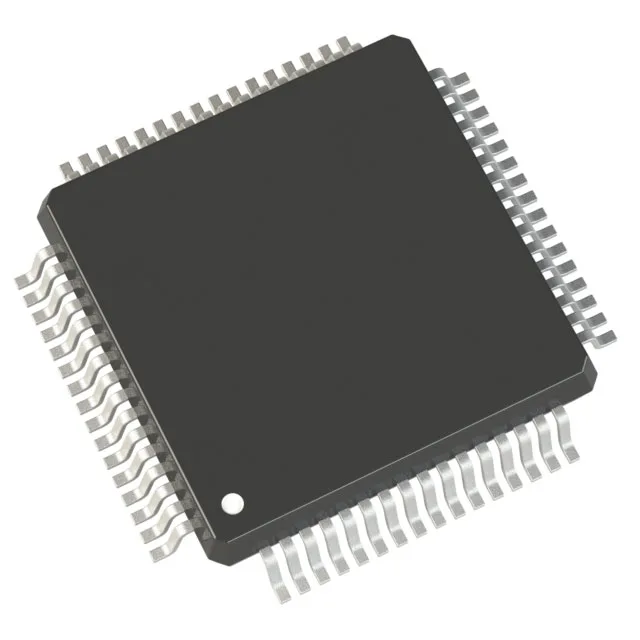
Package and footprint — 64-LQFP (10x10 mm)
The 51 I/O lines give plenty of GPIO for parallel interfaces, keypad matrices, or LED drivers. The exposed pad (if present on this variant) should be stitched to ground with thermal vias for best heat transfer, though at 48 MHz and typical current draw of 20-30 mA, thermal dissipation is rarely a concern.
It is not AEC-Q100 qualified, so it is not recommended for under-hood automotive or engine-bay applications.
The ROHS3 compliance covers EU regulatory requirements for new equipment.