3.3 V fixed LDO with 1 µA Iq for always-on rails
The STLQ020C33R: Its 1 µA typical quiescent current makes it a fit for battery-powered or always-on domains where the regulator's own draw must stay below the single-digit microamp range to preserve standby life. Maximum supply current is 150 µA across load and temperature — the part does not waste headroom current when the output is lightly loaded, which is the dominant operating condition in a sensor node or a microcontroller keep-alive rail.
Dropout and PSRR — the two numbers that decide the rail quality
Maximum dropout voltage is 0.16 V at 200 mA load — the input rail must stay at least 160 mV above 3.3 V across the full load range, or the output falls out of regulation. A 3.6 V nominal lithium cell sitting at 3.45 V under load still holds margin; a 3.3 V rail fed from a 3.5 V switcher post-filter does not. PSRR measures 52 dB at 100 Hz, rolling to 45 dB at 10 kHz. This means the LDO attenuates 100 Hz ripple (rectifier buzz) by a factor of ~400, but at 10 kHz the attenuation drops to ~180×. Upstream switching noise above 10 kHz passes through more readily — a post-LDO ceramic cap with low ESL helps maintain rejection at higher frequencies.
SOT-323-5 footprint and temperature grade
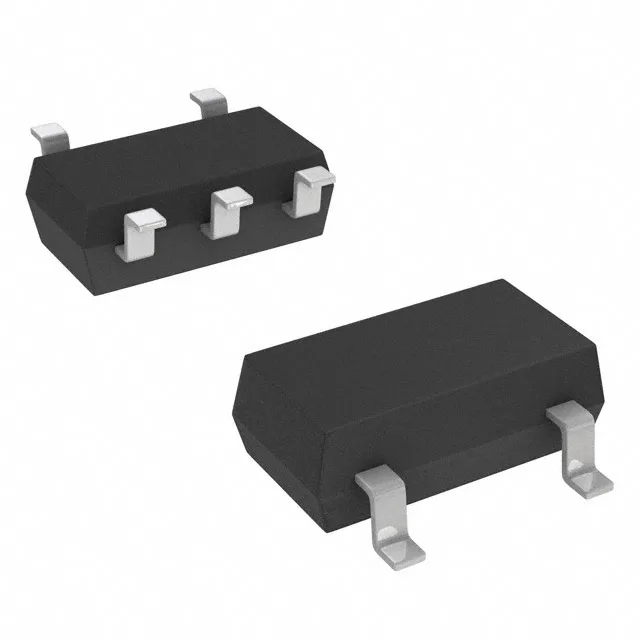
Packaged in SOT-323-5 (also designated SC-70-5 / SOT-353), the STLQ020C33R occupies a 2.0 mm × 2.1 mm footprint with 0.65 mm pin pitch — a space-constrained layout where every square millimetre counts. The supplier device package is SOT-323-5; the same mechanical outline accepts both Tape & Reel and Cut Tape options for prototyping or production. The 125°C ceiling covers under-hood ambient plus self-heating at 200 mA; derating the output current above 85°C ambient keeps the junction within the limit.
Protection and compliance
Built-in over-current and over-temperature protection — the LDO folds back output current during a fault and shuts down if the die temperature exceeds the thermal limit, then auto-recovers when the fault clears. No external protection diode is needed for the output cap discharge path.