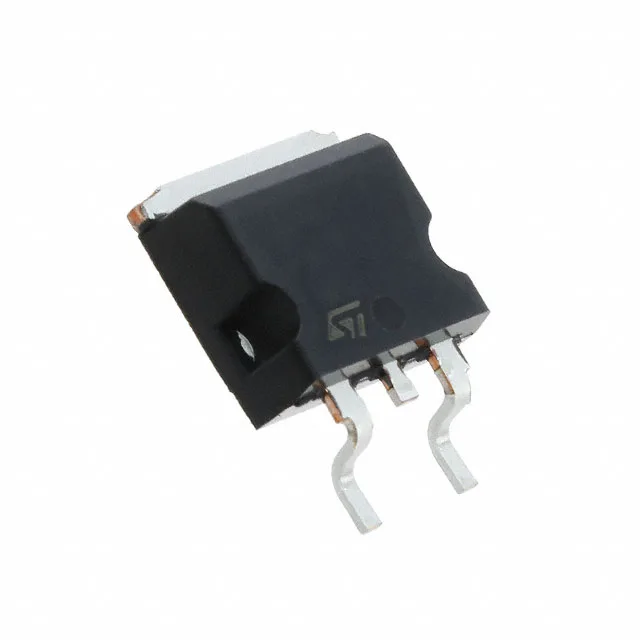
600 V, 30 A Trench Field Stop IGBT for motor-drive and power-conversion stages
The STGB15H60DF is a 600 V, 30 A Trench Field Stop IGBT from STMicroelectronics, housed in a surface-mount D²Pak (TO-263AB) package. It is designed for medium-frequency switching applications such as motor drives, uninterruptible power supplies, induction heating, and solar inverters where low conduction and switching losses are required. The Trench Field Stop structure delivers a low Vce(on) of 2 V at 15 V gate drive and 15 A collector current, combined with fast switching characterised by 24.5 ns turn-on and 118 ns turn-off delay times at 25°C.
Switching losses and gate-drive budget
Total switching energy is 136 µJ during turn-on and 207 µJ during turn-off, measured at 400 V, 15 A, 10 Ω gate resistor, and 15 V gate drive. These numbers let you calculate the switching loss contribution at your operating frequency: at 20 kHz, the per-pulse loss sum of 343 µJ translates to roughly 6.9 W of switching dissipation, which must be added to the conduction loss to size the heatsink. The 81 nC total gate charge sets the average gate-drive current required. Driving the gate at 20 kHz with a 15 V swing demands about 81 nC × 20 kHz = 1.6 mA average from the driver, well within the capability of most standard gate-drive ICs. The reverse recovery time of the internal diode is 103 ns, which matters for hard-switched topologies where the diode recovery contributes to turn-on loss.
Thermal and package considerations for the D²Pak
The 175°C maximum junction allows headroom above the typical 150°C limit of many IGBTs, but the thermal impedance from junction to case must be managed with adequate PCB copper area on the drain tab. For the 115 W maximum power dissipation to be usable, the PCB must provide a low-thermal-resistance path through multiple vias to an internal or backside copper plane. The 60 A pulsed collector current rating (Icm) confirms the die can handle short overloads, but the package solder joint and PCB copper must survive the associated thermal cycling.