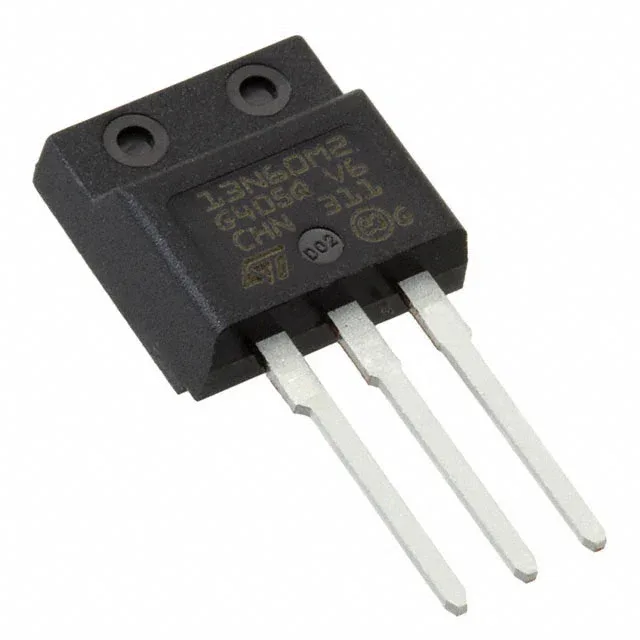
It comes in a through-hole TO-251-3 (IPak) package — the short-lead variant that suits compact, low-profile board layouts where a full TO-220 lead form is too tall. The MDmesh II Plus technology gives you a fast-recovery body diode and good dv/dt ruggedness, which matters in hard-switching topologies like flyback and PFC stages where the diode conducts during dead time.
780 mOhm on-resistance — sizing the conduction loss
That is the figure you use for worst-case conduction loss in the thermal budget. At 5.5 A the Rds(on) will be higher than the 780 mOhm number — the datasheet curve matters for the real operating point. The drive voltage spec is 10 V for the lowest Rds(on); if your gate drive is 5 V only, expect the on-resistance to roughly double, so check the transfer characteristic before locking the gate-drive rail.
These are low numbers for a 600 V part — the gate driver does not need to supply much current, and switching losses at moderate frequencies (say 65–100 kHz) stay manageable. The low Qg also means the Miller plateau is short, which helps reduce cross-conduction in half-bridge configurations. Keep the gate loop tight on the PCB to avoid ringing; the ±25 V maximum gate rating gives some headroom for overshoot.
Package and handling — TO-251 (IPak) with short leads
The STFI9N60M2 is supplied in a TO-251-3 package (IPak, TO-251AA) with short leads — a through-hole package that takes up less board height than a TO-220. The tab is not electrically isolated from the drain, so the heatsink or mounting surface must be insulated or kept at drain potential. No lab bench needed for the swap — standard soldering iron and a pair of cutters if you are replacing one on a board.