RS-485 transceiver for 15 Mbps automotive buses
The ST3485EIYDT is a half-duplex RS-485/RS-422 transceiver from STMicroelectronics, packing one driver and one receiver into an 8-SOIC footprint. It hits 15 Mbps on the bus — fast enough for multi-drop sensor networks and actuator links in engine-bay or chassis-domain ECUs where the protocol layer runs at several megabaud. Rated for 3 V to 3.6 V supply, it runs off a 3.3 V rail common in automotive mixed-signal boards. The 70 mV receiver hysteresis filters out noise on long twisted-pair runs without external schmitt-trigger gates. AEC-Q100 qualification and the -40 °C to +125 °C operating range place it in the under-hood temperature band — a transmission ECU or brake controller that sees 105 °C on a hot day still has margin before the silicon derates.
Package and sourcing reality
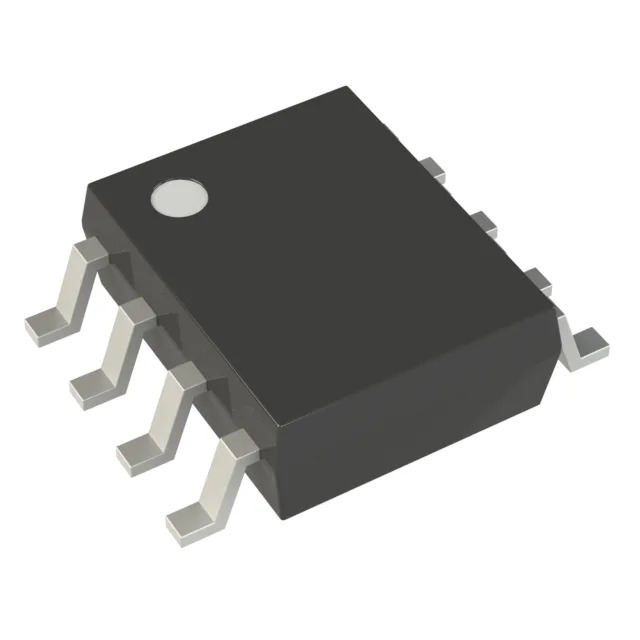
Active lifecycle status — no NRND flag. The 8-SOIC (0.154", 3.90 mm width) package is a standard footprint; the laser etch on the top side carries the date-code in ST's consistent font, and the tape-and-reel packaging from an authorized channel means the lot trace is clean from the wafer fab to the reel label. ROHS3 compliant.
Why the 70 mV hysteresis matters on a long stub
Receiver hysteresis of 70 mV sets the noise immunity floor for the differential input. On a 100-meter RS-485 stub with 24 AWG twisted pair, common-mode noise from nearby motor drives couples into the cable; the hysteresis prevents the receiver from toggling on sub-threshold noise edges that a 50 mV hysteresis part would pass through as false data. The 1/1 driver/receiver count is the standard for a single-drop node. If the BOM calls for a multi-drop bus with more than 32 unit loads, the ST3485EIYDT's driver handles one node; a repeater or a higher-drive part is needed for larger networks.