e200z0h core at 64 MHz — what the speed buys in an automotive ECU
The SPC560B50L5C6E0Y: For an engine-management or transmission-control unit, that clock rate is enough to execute a crank-angle-synchronous control loop at 10 kHz with headroom for diagnostics and CAN communication — the flash fetch and DMA transfers run concurrently without starving the core. The 32-bit data path and the internal oscillator mean the part boots without an external crystal — one less BOM line for a body controller or gateway module where board space is tight.
Automotive temperature grade and supply-voltage range
The Vcc range of 3V to 5.5V covers a nominal 12V battery rail after the pre-regulator, and the 5V logic level is compatible with legacy sensor interfaces that haven't migrated to 3.3V. AEC-Q100 qualification means the silicon has passed the full reliability stress suite — HTOL, ESD, latch-up, and temperature cycling — so a tier-1 supplier can release the BOM without a separate qualification run.
Peripheral set for real-time control and in-vehicle networking
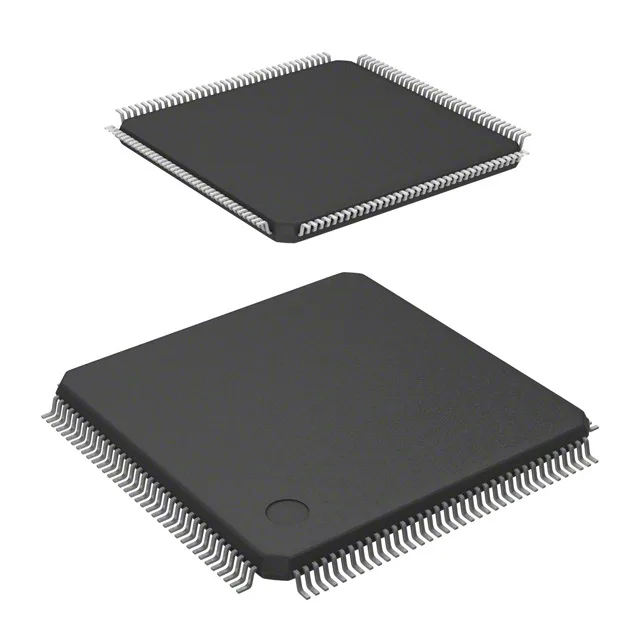
Connectivity includes CANbus, I²C, LINbus, SCI, and SPI — the CAN and LIN interfaces are the standard physical layers for body and powertrain networks; the SCI and SPI handle local sensor acquisition and actuator drivers. With 123 I/O lines in the 144-LQFP package, the part can capture a 36-channel 10-bit ADC and drive a PWM-modulated solenoid bank without external muxing. The DMA, POR, PWM, and WDT peripherals cover the housekeeping tasks — the DMA moves ADC results to RAM without core intervention, the windowed watchdog resets the system if the control loop stalls, and the PWM timers generate the switching patterns for solenoid or relay drivers.
Package footprint and board-fit constraints
Surface-mount assembly is standard reflow; the tray packaging is typical for this pin count in production programming.