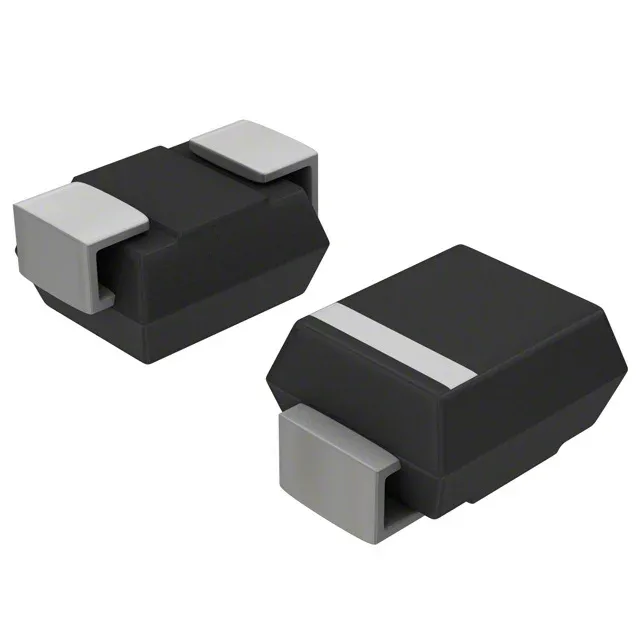
What this TVS diode does on the board
The bidirectional configuration means a single device protects lines that swing both positive and negative relative to ground — useful for AC signal lines, RS-485 buses, or power rails where polarity reversal is possible.
400W peak pulse — what it handles
For a 48V rail, the clamping voltage maxes out at 100V at the rated 23A peak pulse current (8/20µs waveform). That means a surge that would otherwise punch through a 60V-rated downstream regulator gets shunted to ground before the oxide breaks down.
With one bidirectional channel, the SMAJ48CA-TR clamps symmetrically in both directions. That saves a board layout from needing two unidirectional TVS diodes back-to-back, which matters when the protected line carries AC or sees reverse-voltage faults. The breakdown voltage starts at 53.3V minimum, so the part begins conducting before the 100V clamp ceiling is reached — giving a defined snap-back characteristic typical of Zener-based suppressors.
DO-214AC SMA footprint and temperature range
No power line protection built in — this is a signal-rail or low-power-supply clamp, not a mains-side MOV replacement.
For dual-sourcing flexibility, the SMAJ series includes multiple voltage variants in the same DO-214AC footprint — a 48V bidirectional is the specific rating, but the base product number SMAJ48 covers the family.