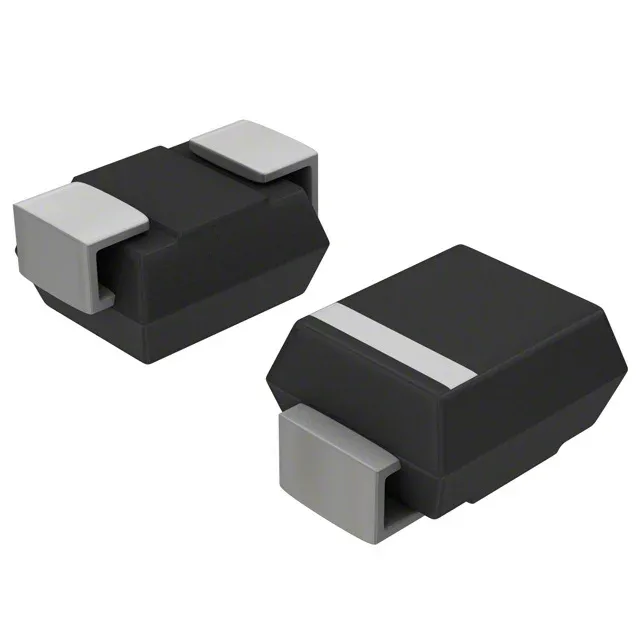
26V rail protection in a DO-214AC package
The 26V reverse standoff voltage means it sits across a 24V or 26V supply bus without conducting in normal operation, then triggers when the transient pushes past the 28.9V minimum breakdown threshold. Clamping maxes out at 53.5V at the peak pulse current of 43A (8/20µs waveform). This is a general-purpose protection diode suited for power supplies, industrial control I/O, and telecom line cards where a single unidirectional clamp per rail is the right topology.
Breakdown and clamping — the protection window
For a 26V rail, the SMAJ26A-TR's 28.9V minimum breakdown gives a guard band of about 2.9V above the nominal bus. That's enough to avoid nuisance triggering from normal ripple or load transients. If your 24V DC-DC converter's input MOSFET is rated for 60V, you've got margin; if it's a 40V part, check the SOA at the clamped level.
Peak pulse power and waveform context
The 43A peak pulse current figure uses the 8/20µs waveform, which is a faster, higher-current pulse typical of ESD or lightning-induced transients. In practice, the 400W rating means this diode can absorb a single 1ms surge of that energy; repetitive events need derating per the thermal curve. For a board-level repair tech, if you find a scorched SMAJ26A-TR on a 24V input, the 400W rating tells you the incoming surge exceeded that — step up to the 600W SMAJ series or add a series resistor.
The wide temp range also means derating at high ambient is less aggressive than with a 125°C-rated device.