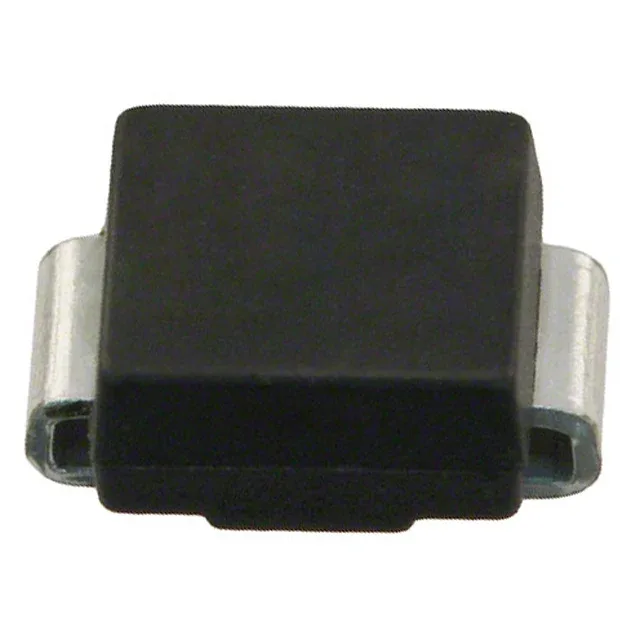
What this TVS is and where it clamps
It is a single-channel device in a surface-mount DO-214AA (SMB) package, rated for a peak pulse power of 600W. The reverse standoff voltage is 6.4V typical, with a minimum breakdown voltage of 7.13V and a maximum clamping voltage of 14.5V at the rated peak pulse current of 276A under an 8/20µs waveform.
AEC-Q101 qualification — what the grade means for your PPAP
For a tier-1 supplier or OEM, this translates to a known reliability baseline: the device is characterized for the temperature range and surge profiles typical of automotive modules. The PPAP documentation (Production Part Approval Process) is available from STMicroelectronics, which is what an auditor will ask for. The SM6T7V5CAY is not merely 'automotive-capable' — it is qualified, with the test data to prove it.
The base product number is SM6T7, covering the family of breakdown voltage variants in the same SMB package.
Package and footprint — DO-214AA SMB
Supplied in a DO-214AA (SMB) package, surface-mount. The supplier device package is SMB (DO-214AA).
The 6.4V reverse standoff voltage means this device will not conduct appreciably below that level, making it suitable for protecting 5V supply rails with margin. The 7.13V minimum breakdown ensures the TVS triggers before the downstream circuitry sees damaging overvoltage. The 14.5V clamp ceiling is the voltage the protected load sees during a surge event — that figure must stay below the absolute maximum rating of the ICs on the rail, which for most 5V automotive logic is around 16V to 20V.