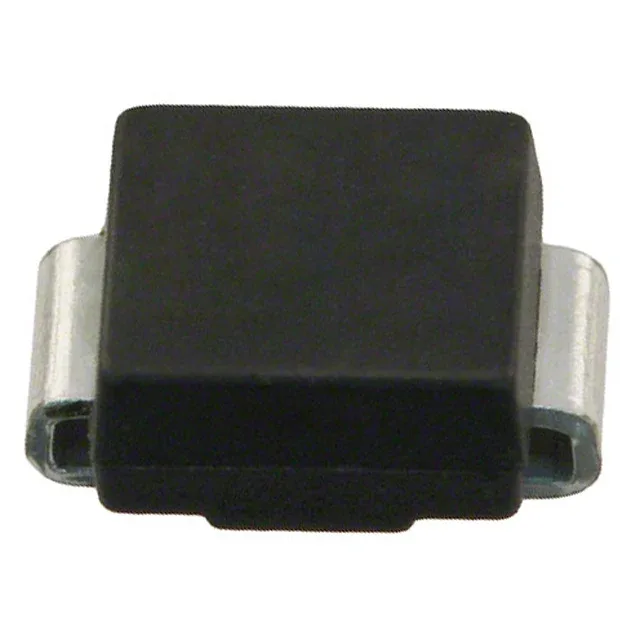
Automotive-grade TVS for 36 V rails
It delivers 600 W peak pulse power (10/1000 µs waveform) with a reverse standoff voltage of 36 V and a maximum clamping voltage of 76 V at the rated peak pulse current of 52 A (8/20 µs).
The 36 V reverse standoff voltage (working voltage) means this diode will not conduct appreciably below 36 V, so it can sit across a 24 V or 28 V nominal rail without leakage issues. The minimum breakdown voltage is 40 V, giving a guard band before avalanche conduction starts. The 76 V clamping voltage is the maximum the diode will force the protected line to during a surge — that figure drives the downstream component voltage rating. For a 36 V standoff part, a 76 V clamp is typical for this power class; the 600 W peak pulse rating (10/1000 µs) defines the energy it can absorb in a single event.
AEC-Q101 qualification and temperature range
AEC-Q101 qualification is the automotive stress test for discrete semiconductors — it covers temperature cycling, high-temperature reverse bias, and humidity bias. The 150°C max junction temperature gives headroom when the diode is absorbing repetitive pulses in a warm enclosure.
The SMB footprint is common across the SM6TY series, so a single PCB land pattern covers the whole voltage range from 5 V to 48 V standoff variants. No power line protection is claimed — this is a unidirectional transient suppressor, not a crowbar or polymer device.
For volume production or dual-source planning, the SM6TY series includes multiple voltage options sharing the same DO-214AA footprint.