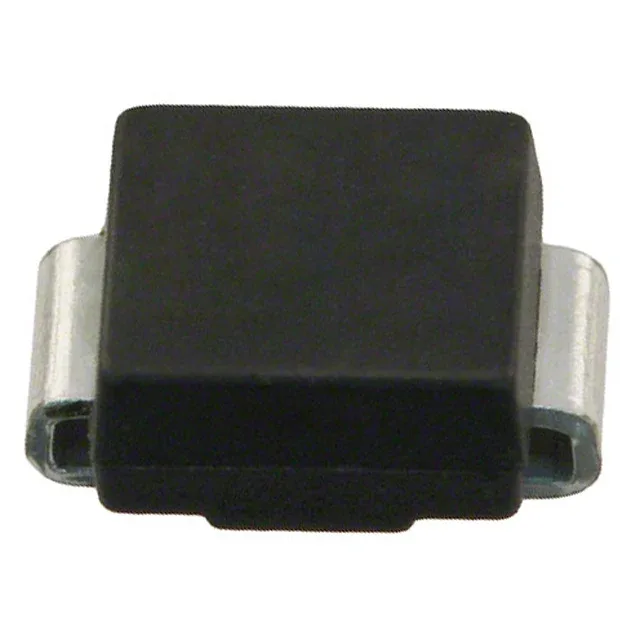
33.3 V standoff — what it protects
Its reverse standoff voltage of 33.3 V means it stays transparent during normal operation, only conducting when a surge pushes the line above the 37.1 V minimum breakdown threshold. With a peak pulse power rating of 600 W (10/1000 µs waveform) and a clamping voltage of 69.7 V at the rated 57 A peak pulse current (8/20 µs), this part handles the kind of inductive load dump or lightning-induced surge you see in industrial control, telecom line cards, and automotive 24 V battery systems. The single bidirectional channel protects both polarities from a single DO-214AA SMB package, saving board space versus two unidirectional devices back-to-back.
600 W peak pulse — sizing the protection
The 600 W rating is the peak pulse power dissipation for an 8/20 µs waveform, which is the standard test for ESD and fast transient immunity per IEC 61000-4-5. For a 24 V nominal rail (like a truck or industrial bus), the 33.3 V standoff gives about 38% headroom above the regulated voltage, so the TVS does not conduct on normal ripple or load steps. The 69.7 V clamping voltage is the maximum the protected circuitry sees during the surge — check that this is below the absolute maximum rating of your downstream ICs. If your transient energy exceeds 600 W for the given pulse width, step up to the SM6T series next-higher power tier or parallel two devices.
Active and RoHS compliant — sourcing posture
It is RoHS compliant per the standard directive, so it fits into lead-free reflow assembly without a waiver.