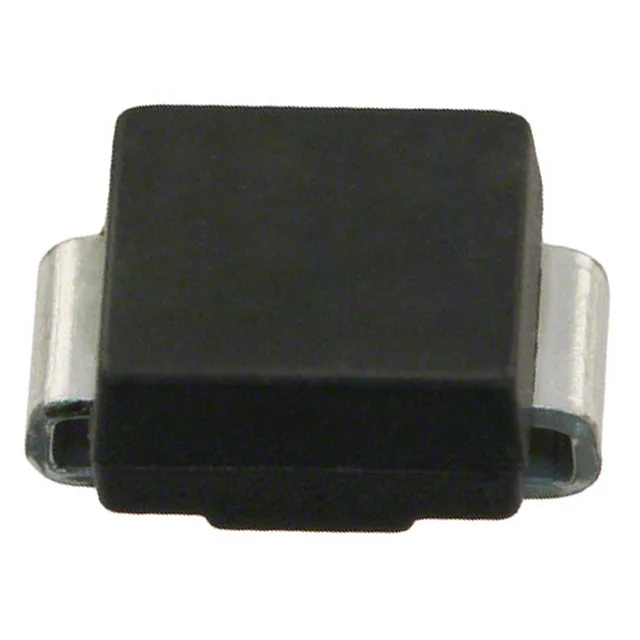
That 600 W rating tells you how much transient energy the part can clamp before the junction fails — not the steady-state dissipation. For a 30.8 V standoff rail, the 64.3 V clamping point means the protected circuitry sees a voltage spike capped at that level during a surge event. The peak pulse current is specified at 62 A for the 8/20 µs waveform, which is the more aggressive automotive transient shape (ISO 7637-2 pulse 1 or 2a). If your load dump or inductive kick exceeds 62 A peak for that pulse shape, you need a larger device or a multi-stage clamp.
Automotive grade and active lifecycle
This part carries AEC-Q101 qualification — the automotive stress test suite for discrete semiconductors. That means it has passed the full set of reliability screens: HTRB, H3TRB, preconditioning, autoclave, temperature cycling, and electrostatic discharge (ESD) robustness. If obsolescence were ever announced, ST typically issues a PCN with a 12- to 18-month LTB window — but that is not the case today.
The SM6T36CAY ships in the DO-214AA (SMB) package, surface-mount. The SMB footprint is a common industry standard shared with many SMBJ and P6SMB series parts, so the PCB layout is straightforward. The bidirectional channel means a single device protects both polarities on the same line, saving board area versus two unidirectional diodes.