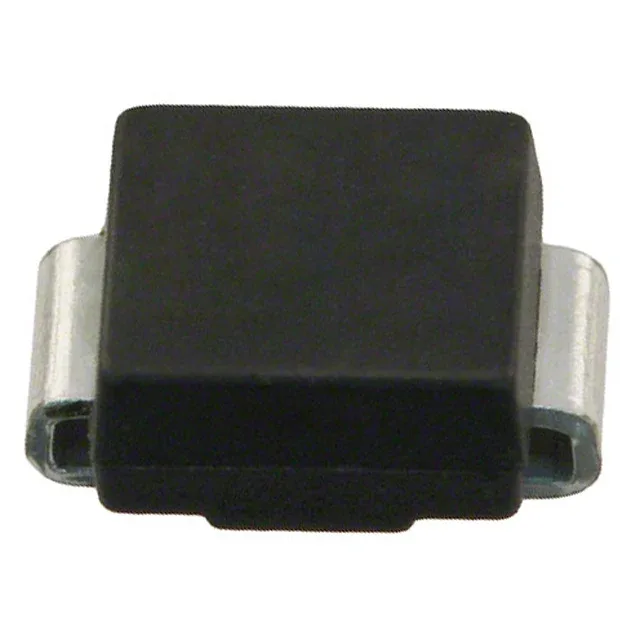
It clamps transients on a nominal 85.5 V rail, with a minimum breakdown voltage of 95 V and a maximum clamping voltage of 178 V at 22.5 A peak pulse current. The single bidirectional channel means you don't have to worry about polarity — it protects AC-coupled or bipolar signal lines just as well as DC power rails. The DO-214AA (SMB) surface-mount package fits standard reflow processes and saves board space compared to axial-leaded alternatives.
Breakdown and clamping — where the protection window sits
With a reverse standoff voltage of 85.5 V, the SM6T100CA stays out of the way during normal operation on a 72 V or 80 V bus. The 95 V minimum breakdown gives a guard band before the device starts conducting. The 178 V maximum clamping voltage is the ceiling the load sees during a surge — make sure your downstream components can survive that peak. The 22.5 A peak pulse current rating (8/20 µs waveform) tells you how much surge it can sink before the junction gives up.
The 150°C upper limit gives headroom for self-heating during repetitive surge events, though derating applies above 25°C — the 600 W rating is for 25°C ambient, so at 85°C you lose about half that capability. Plan your thermal margin accordingly if the part sits near a hot regulator or in a sealed enclosure.