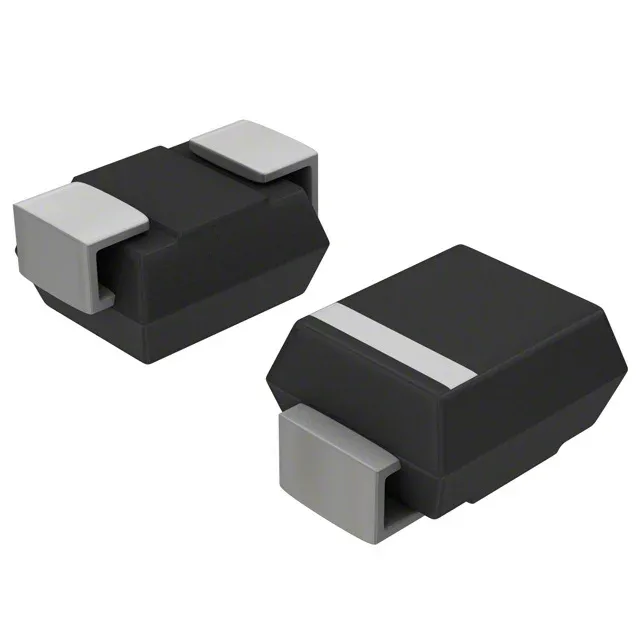
What the 400W peak pulse rating means for your automotive ECU
It clamps transients on 43V nominal rails (reverse standoff) to 91V maximum, absorbing 400W of peak pulse power per the 10/1000µs waveform. The 25A peak pulse current rating (8/20µs) covers ISO 7637-2 pulses common in 24V truck and 12V passenger-car ECUs.
Breakdown, clamping, and standoff — the three numbers that decide fit
Minimum breakdown voltage is 47.8V, so the device starts conducting around 48V. The 43V reverse standoff voltage is the DC rail level the TVS leaves untouched during normal operation — a 48V nominal bus would be too close; this is sized for 24V or 12V systems where the steady-state rail stays well below 43V. Maximum clamping at peak pulse current is 91V, which sets the voltage stress the downstream silicon must survive. For a 24V truck ECU with a 60V-rated input cap, the 91V clamp is within the margin if the TVS is placed directly at the connector.
The TRANSIL series designation is ST's own process for planar passivated junctions, giving stable leakage over temperature.
The base product number SM4T50 covers unidirectional and bidirectional variants in the same SMA footprint, simplifying alternate-source qualification if needed.