Its reverse standoff voltage of 28V means it sits across the supply line without conducting during normal operation, then avalanches at a minimum breakdown of 31.1V to shunt the surge. The maximum clamping voltage of 59V at the peak pulse current tells you the highest voltage the protected circuit will see during a 10/1000µs transient — a 400W peak pulse power rating confirms it can absorb that energy without failing short. This part is AEC-Q101 qualified, so it carries the reliability screening for automotive environments: engine bay, chassis modules, and any 28V bus that sees load-dump or inductive kickback.
Automotive-grade transient suppression — the AEC-Q101 difference
AEC-Q101 qualification means this device passed the Automotive Electronics Council's stress tests for discrete semiconductors: high-temperature reverse bias, temperature cycling, humidity bias, and repeated surge pulses. For a BOM destined for under-hood or chassis-domain electronics, that qualification is the baseline — it saves the qualification paperwork burden and reduces the risk of field failures from marginal parts.
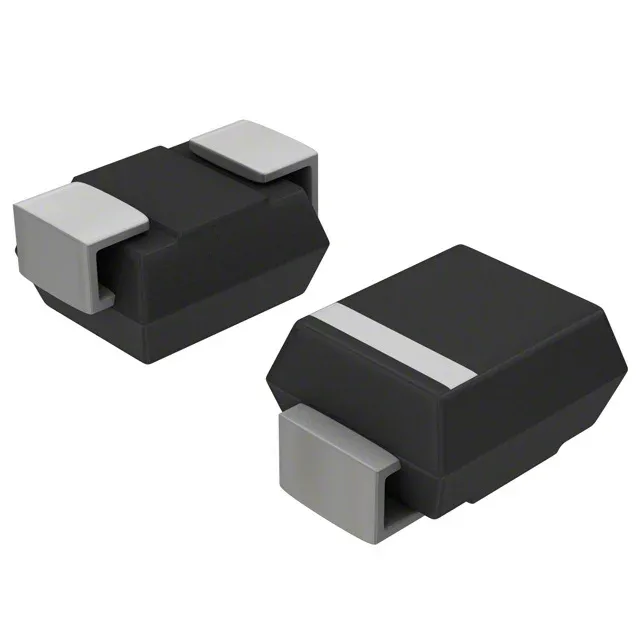
Package and footprint — DO-214AC (SMA)
The SM4T33CAY comes in a DO-214AC (SMA) package, a standard surface-mount footprint for power-handling diodes. The SMA body is small enough for dense PCB layouts but large enough to dissipate the 400W pulse without excessive board copper. Mounting is surface-mount only, so it flows through the same reflow profile as the rest of the board.