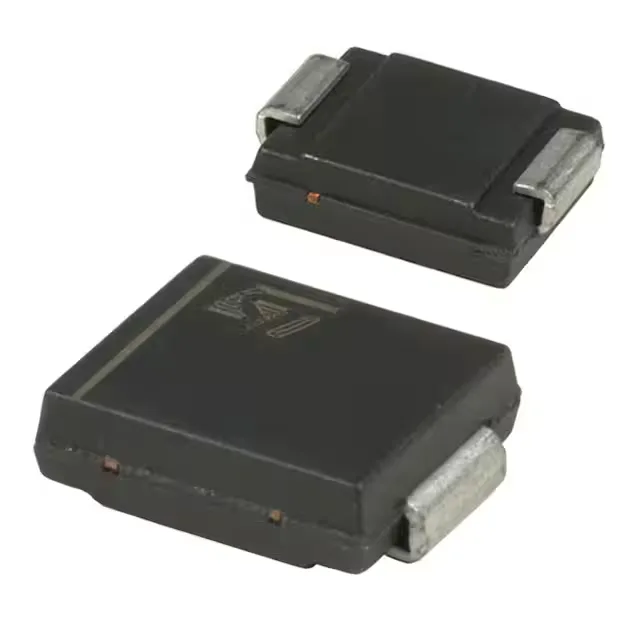
That 3 kW rating means it can absorb a serious transient — think load-dump or inductive kickback on a 24 V or 28 V nominal rail — without the part giving up. The 33 V reverse standoff voltage is the maximum DC voltage the diode will not conduct at; the 36.7 V minimum breakdown is where it starts clamping, and the 53.3 V maximum clamp at 56.3 A is the voltage the protected circuit sees during the event. For a 24 V automotive bus, this gives a healthy margin above the normal operating range while keeping the clamp below typical semiconductor breakdown thresholds.
AEC-Q101 and the automotive build
DO-214AB (SMC) — footprint and rework
The SM30T39AY comes in the DO-214AB (SMC) surface-mount package. It is a standard two-pad footprint with a large tab for thermal transfer — the 3 kW pulse generates heat that needs to get into the PCB copper, so a solid via stitch under the pad is worth the board space. The package is large enough to hand-solder with a fine-tip iron if you are doing a field repair, though a hot-air station makes a cleaner swap. Orientation is marked by a cathode band on the body; the band end is the cathode, which connects to the positive rail in a typical reverse-polarity protection or clamping circuit.
Sourcing and the BOM line
For a production BOM, the AEC-Q101 qualification and the active lifecycle remove the usual single-source anxiety — no need to dual-source unless you want a second qualified supplier for volume leverage. The base product number is SM30T39, so any variant suffix (SM30T39AY, SM30T39A, etc.) shares the same die and package, differing only in testing or packaging options.