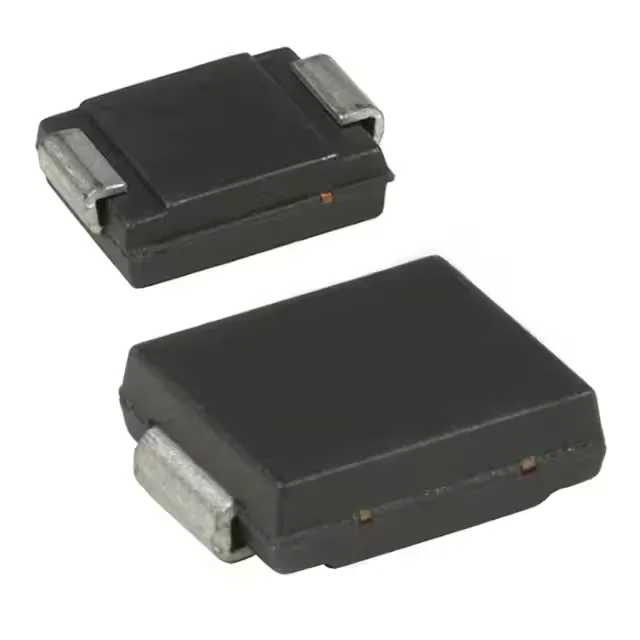
Automotive transient suppressor for 18 V rails
It is rated for a peak pulse power of 3000 W (10/1000 µs waveform), with a reverse standoff voltage of 18 V and a maximum clamping voltage of 29.2 V at a peak pulse current of 102.7 A.
3 kW clamping — what it buys the BOM
For an 18 V nominal rail, the 29.2 V clamp means downstream DC-DC converters and ASICs see a peak voltage well within their 30–36 V absolute maximum ratings, even during a severe load-dump event. The 102.7 A peak pulse current handling is sized for direct battery-line protection in 12 V automotive systems where alternator field decay or a jumped battery can inject hundreds of amps for a few milliseconds. A lower-rated TVS would either fail short or let the clamp voltage rise above the downstream silicon's breakdown threshold.
The SM30T21CAY is housed in a DO-214AB (SMC) package, a surface-mount footprint common for medium-power TVS diodes. The SMC body handles the thermal dissipation of a 3 kW pulse without requiring a heatsink, relying on the PCB copper pad and solder joint to sink the transient heat. The bidirectional configuration means a single device protects both polarities on a line, saving board space compared to a back-to-back unipolar pair.
The AEC-Q101 qualification provides the PPAP and change-control traceability that tier-1 automotive suppliers require for safety and reliability audits. The device is also part of the SM30TY series, which includes multiple voltage variants in the same SMC footprint, simplifying second-source qualification across the same board layout.