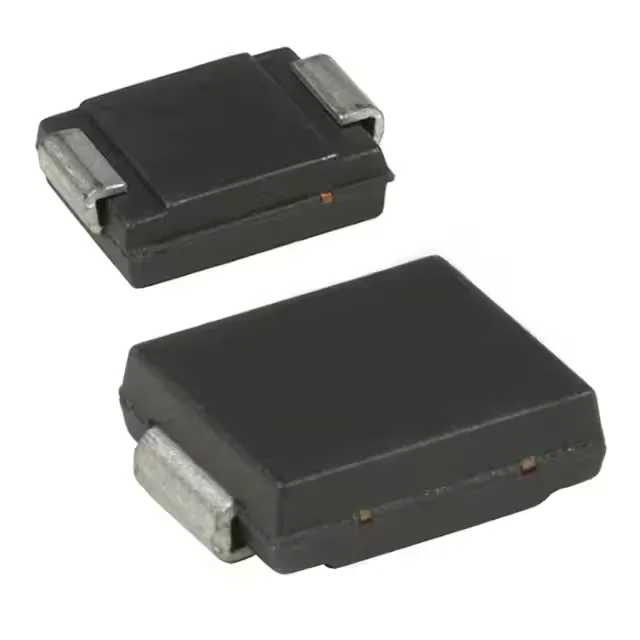
The 30.8V reverse standoff voltage and 64.3V maximum clamping make it a fit for 24V automotive electrical systems — think ECU input protection, alternator load-dump clamps, and sensor supply rail clamping on trucks or heavy equipment.
The 64.3V maximum clamping voltage at 156A peak pulse current (8/20µs waveform) is the number that decides whether the downstream silicon survives a surge. For a 24V nominal rail that can ride through 36V load-dump transients, this TVS clamps hard enough to keep a downstream DC-DC or linear regulator inside its absolute-maximum input rating. The 1500W peak pulse power rating means it can absorb a single 10/1000µs surge of that energy — enough for ISO 7637-2 pulse 5a/5b load dump without the part failing short. If your transient is longer or repetitive, you need to check the thermal derating curve, but for typical automotive transient protection this is the right energy class.
Automotive grade and AEC-Q101 — why it matters for the BOM
The AEC-Q101 qualification is the reason this part costs more than a commercial SM15T36A. For a production BOM that requires PPAP or an IATF 16949 traceable supply chain, the SM15T36CAY is the correct line item. The commercial-grade SM15T36A shares the same die and package but lacks the qualification paperwork — a substitution that an automotive customer's quality team will flag at audit.
Bidirectional device — orientation does not matter for function. SMC body. No exposed thermal pad; junction-to-lead thermal path through solder joints and PCB copper pour.