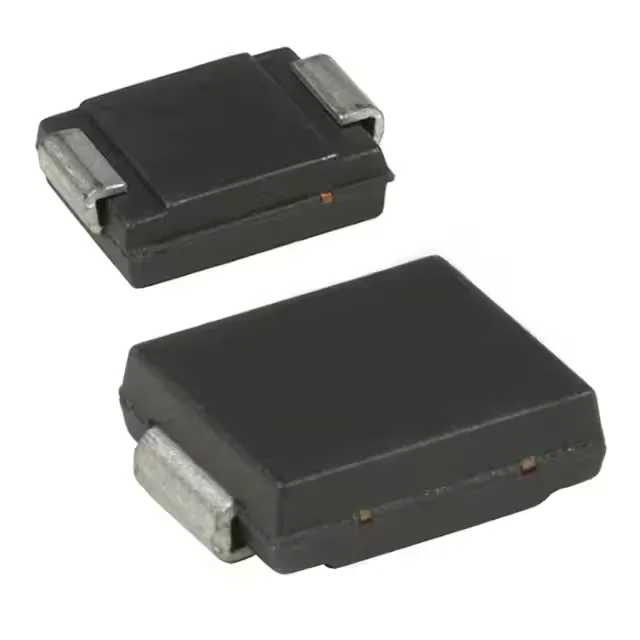
1500 W bidirectional TVS in a DO-214AB SMC package
The device offers a reverse standoff voltage of 28.2 V, a minimum breakdown voltage of 31.4 V, and a maximum clamping voltage of 59 V at the rated peak pulse current of 169 A (8/20 µs waveform).
The 31.4 V minimum breakdown voltage is where the device starts to avalanche, and the 59 V clamping voltage is the maximum voltage the load sees during a surge event. For a 24 V nominal supply rail (common in industrial control and automotive systems), the 28.2 V standoff provides adequate margin against steady-state tolerances, while the 59 V clamp keeps transients below typical downstream component ratings. The 1500 W peak pulse power (10/1000 µs) translates to the energy the diode can absorb in a single surge event; for shorter pulses (8/20 µs) the peak current capability rises to 169 A, which is the figure used for lightning-surge coordination per IEC 61000-4-5.
Bidirectional — one device for AC or bipolar protection
This is the correct choice for protecting AC signal lines, bipolar supplies (±24 V), or data lines where the signal swings above and below ground. In a DC rail application, a unidirectional TVS (such as the SM15T33A) would offer a lower clamping voltage for the same standoff because the forward drop is not in the clamp path, but the bidirectional part simplifies BOM by removing polarity concerns during assembly. The DO-214AB (SMC) package footprint is larger than the smaller SMA/SMB variants, which translates to better thermal dissipation for sustained surge events — a factor when the TVS must absorb multiple pulses in rapid succession.