Clamping voltage and standoff — what they mean for protection
When a surge hits, the device breaks down at 209 V minimum and clamps the transient to 388 V maximum at the rated peak pulse current of 26 A (8/20 µs waveform).
The 1500 W (1.5 kW) peak pulse power rating applies to the 10/1000 µs waveform. For shorter pulses, such as the 8/20 µs waveform used in IEC 61000-4-5, the device can handle significantly higher peak current — the 26 A figure is for that shorter pulse. When you size the TVS, match the waveform and energy of your expected surge to the datasheet curves; the 1500 W number is a reference point, not a hard limit across all pulse shapes.
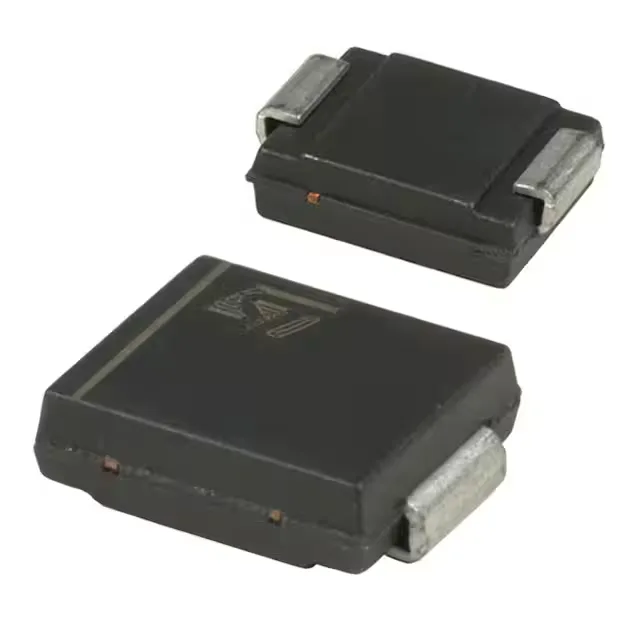
Housed in the DO-214AB (SMC) surface-mount package, the SM15T220A uses the same footprint as other 1500 W TVS diodes from ST and competitors — a standard land pattern that simplifies board layout. No power line protection is built in (the part is unidirectional), so for AC mains protection you would need a bidirectional or two devices back-to-back.