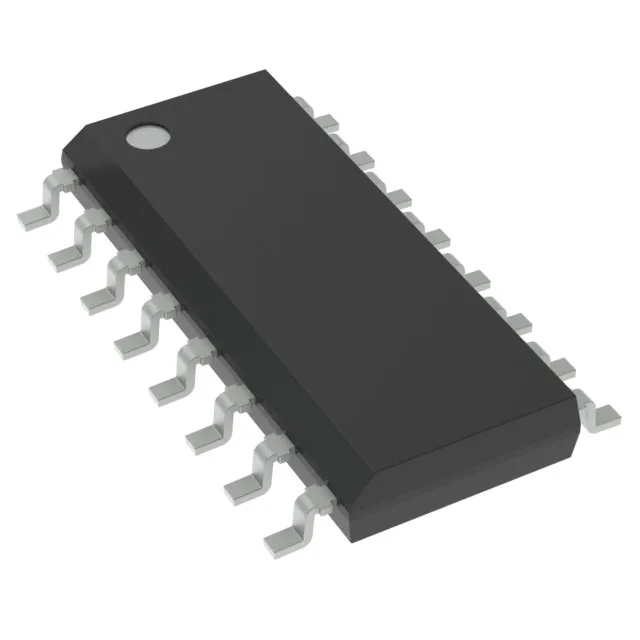
SG3525AP013TR

STMicroelectronics

STMicroelectronics SG3525AP013TR, PWM Controller, Step-Down/Step-Up/Step-Down, Buck/Push-Pull Topology, 100Hz-400kHz Switching, 49% Max Duty Cycle, 8V-35V Supply, 16-SOIC Package, Active, ROHS3 Compliant.

STMicroelectronics SG3525AP013TR
Download datasheet (PDF)
[IN STOCK] In Stock: 11,484 pcs
$0.92/ pc

Volume pricing

Buy Now

MOQ 1 · Tape & Reel (TR) Cut Tape (CT) · RoHS · EIA-481 · DAP/DDP · T/T

Technical specifications

SG3525AP013TR specifications
Parameter / AttributeSpecification / Value
Output typeTransistor Driver
MountingSurface Mount
Voltage - supply (Vcc (Vdd))8V ~ 35V
Frequency - switching100Hz ~ 400kHz
I/O channels2
Output phases1
Duty cycle49%
Operating temperature0°C ~ 70°C (TA)
PackageTape & Reel (TR) Cut Tape (CT)
FunctionStep-Down, Step-Up/Step-Down
TopologyBuck, Push-Pull
Clock syncYes
Case16-SOIC (0.154\", 3.90mm Width)
Control featuresEnable, Soft Start
Output configurationPositive
Synchronous rectifierYes
100% Footprint Match · Solder-Ready (No PCB Redesign Needed)

Need Stock or a Drop-in Second-Source for SG3525AP013TR?

Package: DIP-16 / SOIC-16 · Pin-compatible replacements with immediate Shenzhen spot stock

Footprint Match 98%
Supply Chain & Allocation Reality:

The SG3525A is the voltage-mode PWM controller that runs the push-pull and half-bridge stages of welder inverters, offline inverters, UPS and battery chargers: 8V to 35V operation, a trimmed 5.1V reference, 100Hz to 400kHz, and +/-400mA totem-pole outputs strong enough to drive MOSFET gates without an external driver - the exact reason welder designers chose it over the TL494 class. Its identity is a triangle of pin-pure second sources (UC3525 from Unitrode, KA3525A from the Fairchild line), and its standing trap is the SG3524, a first-generation ancestor whose name sits digits away and whose control pins do not map.

Verified Pin-Compatible Replacements (3 verified alternatives)

UC3525A TI (Unitrode lineage) DIP-16 / SOIC-16
100% Drop-in (Zero Code Change)
Availability & Target Pricing:

The Original Unitrode Second Source

Shenzhen Spot Stock (24-48h Dispatch)

Electrical & Core Specs:

The pin-and-function-identical original: every controller pin in place, the same 5.1V reference, the same oscillator programming through RT, CT and the discharge pin, the same soft-start and shutdown behavior.

8V to 35V operation; the output stage sinks and sources the same +/-400mA class.

Compatibility & Drop-In Notes: Substitution inside the triangle is pin-pure in both directions: stock whichever lot prices best, keep one tube of each as bench spares.
Package & Solder Footprint: DIP-16 / SOIC-16 shared across the family.
Shenzhen Warehouse Stock & MOQ: Continuous multi-fab supply; quote across the triangle.
TL494 TI (original) / onsemi / Fairchild line DIP-16 / SOIC-16
Functional Equivalent
Availability & Target Pricing:

The Rival Standard in the Same Body

Shenzhen Spot Stock (24-48h Dispatch)

Electrical & Core Specs:

The other inverter PWM generation in a 16-pin body: two error amplifiers instead of one, 250mA-class drive, about 200kHz top oscillator - and a completely different pin assignment inside the same plastic.

Similar supply envelope; the control architecture differs - dead-time and output-control pins exist where the SG3525 puts sync and discharge.

Compatibility & Drop-In Notes: The substitution rule is the reason both get their own pages: same body, same job description, incompatible pinouts. "16-pin PWM controller" is not a part number.
Package & Solder Footprint: DIP-16 shared; pin functions are not.
Shenzhen Warehouse Stock & MOQ: Stocked; match the controller the schematic was drawn around.
SG3524 TI (original) / multiple DIP-16
Functional Equivalent
Availability & Target Pricing:

The First Generation - Similar Name, Different Pins

Shenzhen Spot Stock (24-48h Dispatch)

Electrical & Core Specs:

The ancestor: same voltage-mode push-pull idea, weaker oscillator drive, untrimmed reference, and no soft-start or dedicated discharge pin - the control functions the 3525 added are exactly the ones repairs touch.

Same supply family; the differences live in the control pins, not the rails.

Compatibility & Drop-In Notes: Repair-list rule: SG3524 to SG3525 is a board modification, not a substitution. Map every control pin against the schematic before fitting the newer part into a genuine 3524 design.
Package & Solder Footprint: Both 16-pin DIP; the similar body is the whole trap.
Shenzhen Warehouse Stock & MOQ: Stocked; tell us the controller generation the board was designed around.
Buyer & Quality Checklist for Sourcing Alternatives
  • The SG3525A / UC3525A / KA3525A triangle is pin-pure - genuine multi-fab second sourcing. The SG3524 name neighbor is not: it is the first generation with different control pins, and treating the two as one part is the classic repair-list error.
  • Soft-start (pin 8) and shutdown (pin 10) are the welder-repair functions: a shorted soft-start capacitor, or an external overcurrent comparator latching shutdown, presents as a dead controller. Check the protection chain before condemning the IC.
  • Deadtime is programmed through the discharge pin into CT: that resistor sets the minimum off-time between the two outputs. A wrong value after repair is shoot-through waiting for the first real load.
  • The trimmed 5.1V reference on pin 16 feeds the error amplifier and often the external setpoints: measure it first. A collapsed reference explains every downstream symptom in one probe.
  • The +/-400mA totem-pole outputs drive MOSFET gates directly; a board that "needs" an external gate driver after a controller swap usually got the wrong controller generation (the 250mA-class part instead).
  • Oscillator range reaches 400kHz where the TL494 class stops near 200kHz: cross-family swaps change the switching frequency and every timing constant around it - stay inside the triangle for repairs.
Frequently Asked Technical Questions

Q: Is the SG3525 pin-compatible with the SG3524?

A: No. The 3525 is the second generation with control pins the 3524 does not have in the same places - sync, oscillator output, the discharge pin for programmable deadtime, and soft-start. Repair lists that treat them as one part produce boards running with deadtime and soft-start unwired.

Q: Can a TL494 replace an SG3525?

A: No - both are 16-pin voltage-mode PWM controllers, but the pinouts and feature sets differ: the TL494 has two error amplifiers and 250mA-class drive; the SG3525 one error amplifier, a trimmed 5.1V reference and +/-400mA totem-pole outputs. The swap is a redesign, not a repair.

Q: Why does the inverter shut down immediately after a controller replacement?

A: Start at the protection chain: the shutdown pin latched by an external overcurrent comparator, a shorted soft-start capacitor on pin 8, or the 5.1V reference not coming up. The controller is usually reporting a fault, not causing it.

Technical details

PWM controller for buck and push-pull converters

The STMicroelectronics SG3525AP013TR is a PWM controller IC designed for step-down (buck) and step-up/step-down (push-pull) topologies. It integrates a transistor driver output stage, clock synchronization capability, and control features including enable and soft start. The device operates from an 8V to 35V supply rail and supports a switching frequency range from 100Hz to 400kHz, with a maximum duty cycle of 49%.

49% duty cycle — why it matters for push-pull

The 49% maximum duty cycle is a deliberate design choice for push-pull converters. It leaves a dead-time gap that prevents simultaneous conduction of both primary-side switches, avoiding transformer saturation and shoot-through current. For buck designs, the same limit still provides adequate output voltage range at typical input-to-output ratios. If your design requires duty cycles above 50%, this controller will not support it — you would need a different topology or a controller with a wider duty-cycle window.

Switching frequency range — sizing the magnetics

The 100Hz to 400kHz switching frequency range gives the designer room to trade off magnetics size against switching losses. At the lower end, transformer and inductor cores are larger but core losses are minimal — useful for noise-sensitive or high-efficiency designs. At the upper end, magnetics shrink but gate-drive and core losses increase. The clock sync feature allows multiple SG3525AP013TR controllers to run at the same frequency, which simplifies input filter design in multi-phase or paralleled converter systems.

The base product number is SG3525, which shares the same pinout and function across the family — if you already use a through-hole or DIP variant, the SOIC-16 footprint is the only difference.

The SG3525AP013TR is supplied in a 16-pin SOIC package with a 3.90mm body width, surface-mount only. The supplier device package is designated 16-SO. No through-hole variant is available for this order code.

SG3525AP013TR
[ALLOC] verified
Quote