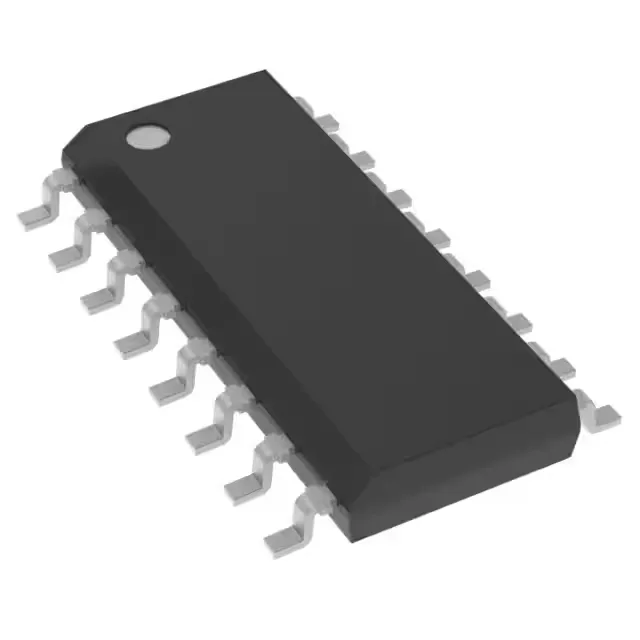
SG3525AP

STMicroelectronics

STMicroelectronics SG3525AP PWM controller, step-down/step-up/step-down function, buck and push-pull topology, 100Hz~400kHz switching frequency, 49% max duty cycle, 8V~35V supply, 16-SOIC package, 0°C~70°C operating temperature.

STMicroelectronics SG3525AP
Download datasheet (PDF)
[QUOTE] Factory Allocation · Direct Sourcing
Target price / quote

Volume pricing available from 1,000+ pcs per order.

MOQ 1 · Tube · RoHS · EIA-481 · DAP/DDP · T/T

Technical specifications

SG3525AP specifications
Parameter / AttributeSpecification / Value
Output typeTransistor Driver
MountingSurface Mount
Voltage - supply (Vcc (Vdd))8V ~ 35V
Frequency - switching100Hz ~ 400kHz
I/O channels2
Output phases1
Duty cycle49%
Operating temperature0°C~70°C(TA)
PackageTube
FunctionStep-Down, Step-Up/Step-Down
TopologyBuck, Push-Pull
Clock syncYes
Case16-SOIC (0.154\", 3.90mm Width)
Control featuresEnable, Soft Start
Output configurationPositive
Synchronous rectifierYes
100% Footprint Match · Solder-Ready (No PCB Redesign Needed)

Need Stock or a Drop-in Second-Source for SG3525AP?

Package: DIP-16 / SOIC-16 · Pin-compatible replacements with immediate Shenzhen spot stock

Footprint Match 98%
Supply Chain & Allocation Reality:

The SG3525A is the voltage-mode PWM controller that runs the push-pull and half-bridge stages of welder inverters, offline inverters, UPS and battery chargers: 8V to 35V operation, a trimmed 5.1V reference, 100Hz to 400kHz, and +/-400mA totem-pole outputs strong enough to drive MOSFET gates without an external driver - the exact reason welder designers chose it over the TL494 class. Its identity is a triangle of pin-pure second sources (UC3525 from Unitrode, KA3525A from the Fairchild line), and its standing trap is the SG3524, a first-generation ancestor whose name sits digits away and whose control pins do not map.

Verified Pin-Compatible Replacements (3 verified alternatives)

UC3525A TI (Unitrode lineage) DIP-16 / SOIC-16
100% Drop-in (Zero Code Change)
Availability & Target Pricing:

The Original Unitrode Second Source

Shenzhen Spot Stock (24-48h Dispatch)

Electrical & Core Specs:

The pin-and-function-identical original: every controller pin in place, the same 5.1V reference, the same oscillator programming through RT, CT and the discharge pin, the same soft-start and shutdown behavior.

8V to 35V operation; the output stage sinks and sources the same +/-400mA class.

Compatibility & Drop-In Notes: Substitution inside the triangle is pin-pure in both directions: stock whichever lot prices best, keep one tube of each as bench spares.
Package & Solder Footprint: DIP-16 / SOIC-16 shared across the family.
Shenzhen Warehouse Stock & MOQ: Continuous multi-fab supply; quote across the triangle.
TL494 TI (original) / onsemi / Fairchild line DIP-16 / SOIC-16
Functional Equivalent
Availability & Target Pricing:

The Rival Standard in the Same Body

Shenzhen Spot Stock (24-48h Dispatch)

Electrical & Core Specs:

The other inverter PWM generation in a 16-pin body: two error amplifiers instead of one, 250mA-class drive, about 200kHz top oscillator - and a completely different pin assignment inside the same plastic.

Similar supply envelope; the control architecture differs - dead-time and output-control pins exist where the SG3525 puts sync and discharge.

Compatibility & Drop-In Notes: The substitution rule is the reason both get their own pages: same body, same job description, incompatible pinouts. "16-pin PWM controller" is not a part number.
Package & Solder Footprint: DIP-16 shared; pin functions are not.
Shenzhen Warehouse Stock & MOQ: Stocked; match the controller the schematic was drawn around.
SG3524 TI (original) / multiple DIP-16
Functional Equivalent
Availability & Target Pricing:

The First Generation - Similar Name, Different Pins

Shenzhen Spot Stock (24-48h Dispatch)

Electrical & Core Specs:

The ancestor: same voltage-mode push-pull idea, weaker oscillator drive, untrimmed reference, and no soft-start or dedicated discharge pin - the control functions the 3525 added are exactly the ones repairs touch.

Same supply family; the differences live in the control pins, not the rails.

Compatibility & Drop-In Notes: Repair-list rule: SG3524 to SG3525 is a board modification, not a substitution. Map every control pin against the schematic before fitting the newer part into a genuine 3524 design.
Package & Solder Footprint: Both 16-pin DIP; the similar body is the whole trap.
Shenzhen Warehouse Stock & MOQ: Stocked; tell us the controller generation the board was designed around.
Buyer & Quality Checklist for Sourcing Alternatives
  • The SG3525A / UC3525A / KA3525A triangle is pin-pure - genuine multi-fab second sourcing. The SG3524 name neighbor is not: it is the first generation with different control pins, and treating the two as one part is the classic repair-list error.
  • Soft-start (pin 8) and shutdown (pin 10) are the welder-repair functions: a shorted soft-start capacitor, or an external overcurrent comparator latching shutdown, presents as a dead controller. Check the protection chain before condemning the IC.
  • Deadtime is programmed through the discharge pin into CT: that resistor sets the minimum off-time between the two outputs. A wrong value after repair is shoot-through waiting for the first real load.
  • The trimmed 5.1V reference on pin 16 feeds the error amplifier and often the external setpoints: measure it first. A collapsed reference explains every downstream symptom in one probe.
  • The +/-400mA totem-pole outputs drive MOSFET gates directly; a board that "needs" an external gate driver after a controller swap usually got the wrong controller generation (the 250mA-class part instead).
  • Oscillator range reaches 400kHz where the TL494 class stops near 200kHz: cross-family swaps change the switching frequency and every timing constant around it - stay inside the triangle for repairs.
Frequently Asked Technical Questions

Q: Is the SG3525 pin-compatible with the SG3524?

A: No. The 3525 is the second generation with control pins the 3524 does not have in the same places - sync, oscillator output, the discharge pin for programmable deadtime, and soft-start. Repair lists that treat them as one part produce boards running with deadtime and soft-start unwired.

Q: Can a TL494 replace an SG3525?

A: No - both are 16-pin voltage-mode PWM controllers, but the pinouts and feature sets differ: the TL494 has two error amplifiers and 250mA-class drive; the SG3525 one error amplifier, a trimmed 5.1V reference and +/-400mA totem-pole outputs. The swap is a redesign, not a repair.

Q: Why does the inverter shut down immediately after a controller replacement?

A: Start at the protection chain: the shutdown pin latched by an external overcurrent comparator, a shorted soft-start capacitor on pin 8, or the 5.1V reference not coming up. The controller is usually reporting a fault, not causing it.

Technical details

What the 49% duty cycle ceiling means for your transformer

The SG3525AP is a fixed-frequency PWM controller from STMicroelectronics, built for push-pull and buck topologies where the 49% maximum duty cycle prevents flux walking in the transformer core. At 49%, the off-time guarantees core reset before the next cycle — skip the dead-time calculation on a half-bridge or push-pull design. Two complementary outputs drive the primary-side MOSFETs directly, with a transistor driver stage rated for the full 8V to 35V supply range. The 100Hz to 400kHz switching window covers line-frequency inverters at the low end and compact DC-DC converters at the high end.

Supply rails and temperature — the fit check

The 8V to 35V Vcc range lets this part run off a 12V or 24V industrial bus without a pre-regulator. Below 8V the undervoltage lockout holds the outputs off; above 35V you need a clamp or a different controller. If the board lives in a motor drive enclosure or under-hood, step to the industrial-grade SG3525A variants.

No last-time-buy notice, no end-of-life window. The 16-SOIC package (0.154-inch body width, 3.90mm) is the standard narrow-body SOIC-16 footprint.

SG3525AP
[ALLOC] verified
Quote