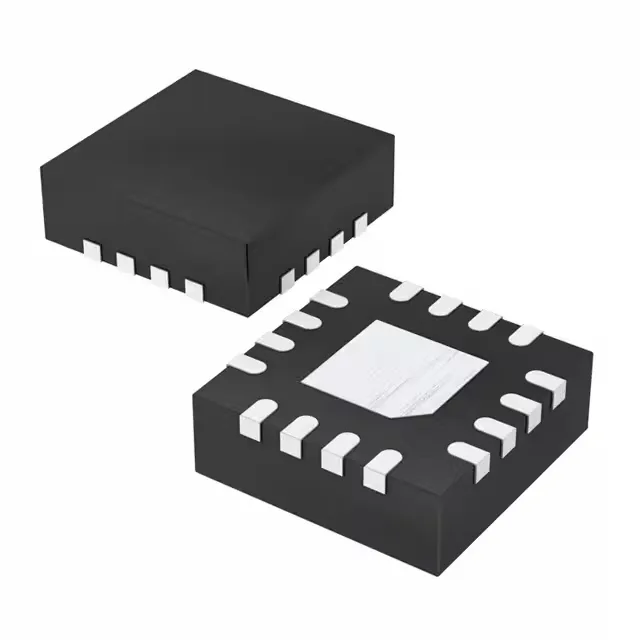
Quad zero-drift amp at 31 µA per channel — the battery-life trade-off
The OA4ZHA33Q is a quad-channel zero-drift operational amplifier from STMicroelectronics, packing four independent amplifiers into a 3x3 mm 16-QFN package. The zero-drift topology continuously autozeroes the input offset, holding it to a typical 1 µV — two orders of magnitude below a standard precision op-amp — so the output error from offset drift over temperature is negligible in DC-coupled signal chains. That is low enough to leave a 100 mAh coin cell powering the amplifier for over 800 hours of continuous operation — relevant for battery-powered sensor interfaces where the op-amp is always on.
400 kHz GBP with 0.19 V/µs slew — the bandwidth ceiling for low-frequency precision
The gain-bandwidth product of 400 kHz and slew rate of 0.19 V/µs set the usable signal bandwidth. For a gain-of-10 stage, the closed-loop bandwidth drops to 40 kHz — adequate for thermocouple conditioning, strain-gauge amplification, or audio-frequency filter stages, but not for high-speed ADC drivers or video paths. The rail-to-rail output stage swings within 50 mV of each supply rail, preserving dynamic range in low-voltage single-supply designs. Input bias current is 70 pA typical, and the input offset voltage is 1 µV typical. The low bias current means the voltage error from source impedance is minimal — a 10 kΩ source adds only 0.7 µV of additional offset, keeping the DC accuracy in the microvolt range.
Industrial temperature grade and 3x3 mm QFN — board-fit for harsh environments
Mounting is surface-mount only. The tape-and-reel packaging option indicates it is supplied on 7-inch or 13-inch reels for automated pick-and-place assembly. The 0.5 mm pitch QFN demands a solder-paste stencil aperture that matches the land pattern — a 0.25 mm square aperture per pad is a common starting point.
Active lifecycle and ROHS3 compliance
It is ROHS3 compliant, meaning no restricted substances above the exemption thresholds — no lead, cadmium, mercury, or phthalates in the package or plating. For new designs, the quad-channel TSZ124IYPT (automotive-qualified, AEC-Q100) shares the same 400 kHz GBP, 0.19 V/µs slew rate, and 1 µV offset — it is the automotive-grade sibling in the same zero-drift family. The dual-channel TSZ122IST and TSZ122IYDT are the two-channel variants if the BOM does not need four amplifiers.