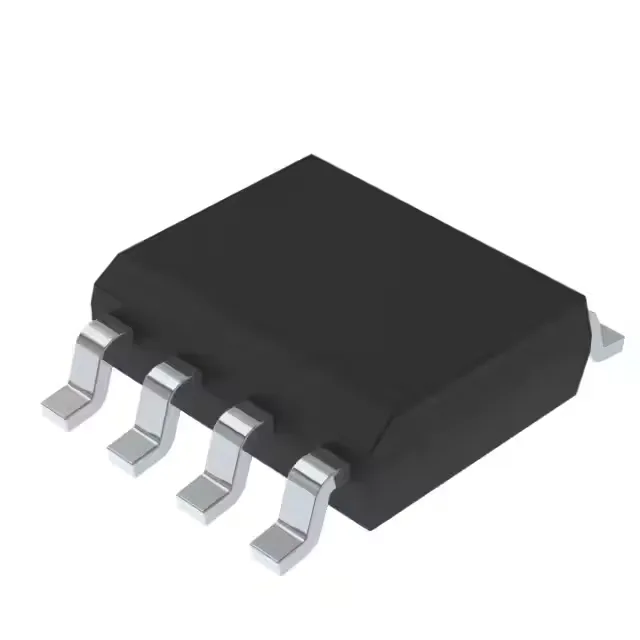
What this 64Kbit I²C EEPROM brings to the board
The STMicroelectronics M24C64-RMN6P is a 64Kbit serial EEPROM organized as 8K x 8 bits, accessed through an I²C interface at clock frequencies up to 1 MHz. That 1 MHz clock puts it in the Fast-mode Plus tier, so it keeps pace with modern MCU I²C peripherals without bus stretching or wait-state penalties. It's housed in an 8-pin SOIC (0.154", 3.90mm width) — a standard footprint that fits into most existing board layouts without a respin.
The write cycle time — 5 ms for a word or page write — is the period the EEPROM takes to program the internal memory array after the I²C master sends the stop condition. During that 5 ms window the part does not acknowledge its own slave address, so the bus master must either poll for ACK or insert a delay. For a 64Kbit device organized as 8K x 8, a full-chip rewrite at one byte per write would take over 40 seconds; page writes (typically 16 bytes per page for this family) bring that down to about 2.6 seconds. If your application writes configuration data infrequently — once per boot or on a field-update event — the 5 ms write time is invisible. But if you are logging sensor data at high rates, you will want to buffer writes in RAM and commit them in page-sized bursts.
If your pick-and-place prefers tape-and-reel, the -RMN6T suffix is the same die in the same package on a 13-inch reel.
Compatibility check: 3.3V logic and RoHS
The 1.8V to 5.5V supply range means this part operates natively on a 3.3V rail. The I²C input thresholds scale with VCC: at 3.3V the low-level input is typically 0.3 x VCC (about 1.0V), and the high-level input is 0.7 x VCC (about 2.3V), so a standard 3.3V CMOS output drives it directly. The part is lead-free and RoHS-compliant per ST's standard material declaration; no separate certification document is in this listing, but the suffix does not carry a leaded (e.g., -E) indicator, consistent with the RoHS-compliant build.