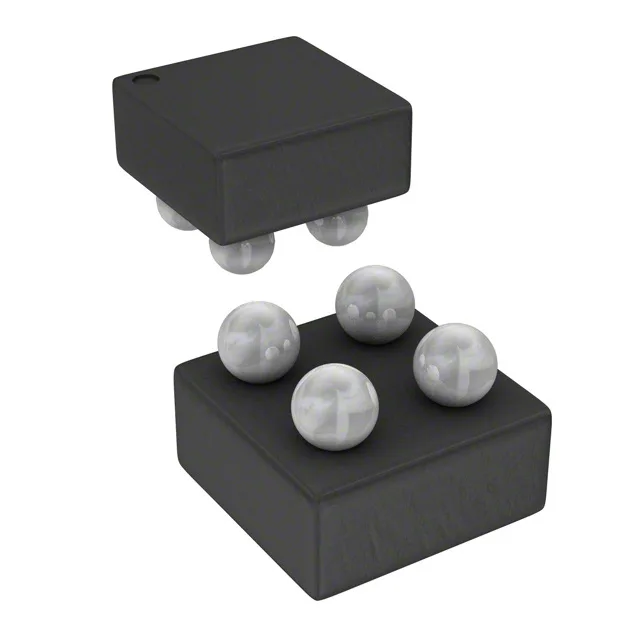
64 Kbit I²C EEPROM in a 4-ball WLCSP — what this chip is
The STMicroelectronics M24C64-FCU6TP/TF is a 64 Kbit serial EEPROM with an I²C interface, organized as 8 K × 8 bits. It clocks at 1 MHz and delivers a 450 ns access time, which means the bus master waits one I²C clock cycle per byte read — a timing detail that matters when you are budgeting read latency in a firmware boot or calibration-load sequence. The 4-XFBGA WLCSP package (0.80 mm × 0.67 mm body) is a wafer-level chip-scale package — no leads, no exposed pad, just four solder balls on the bottom.
STMicroelectronics no longer manufactures this specific variant in the 4-WLCSP package. For a production BOM that already uses this order code, the path forward is either sourcing existing stock through independent distribution or qualifying a replacement. The base product number M24C64 covers a broad family of 64 Kbit I²C EEPROMs in different packages — SOIC, TSSOP, UFDFPN — but the FCU6 suffix is unique to the WLCSP variant, so a pin-compatible drop-in in the same footprint does not exist in the active M24C64 line. Any replacement will require a PCB layout change or a package adapter.
1 MHz I²C and 450 ns access — sizing the bus timing
The 1 MHz clock frequency is the maximum SCL rate for this device. At that speed, the I²C bus runs in fast-mode plus (Fm+). If your host controller runs a bit-banged I²C or a slow MCU with marginal I²C timing, the 450 ns window is tight; a 400 kHz bus clock gives more margin. The write cycle time is 5 ms per page or byte, which is the period after a STOP condition during which the EEPROM is busy programming — the master must not send another command during that window.
WLCSP package — layout and assembly notes
The 4-WLCSP package measures 0.80 mm × 0.67 mm with a 0.40 mm ball pitch. That is a fine-pitch wafer-level chip-scale package — no molded body, just the silicon die with solder balls directly attached. The PCB land pattern must match the ball layout exactly; there is no room for via-in-pad without filling and capping. The package is moisture-sensitive, so MSL handling procedures apply. For rework, a hot-air nozzle sized for a 1 mm × 1 mm die works, but the small ball size makes alignment critical — optical alignment under a microscope is standard practice in a rework lab.