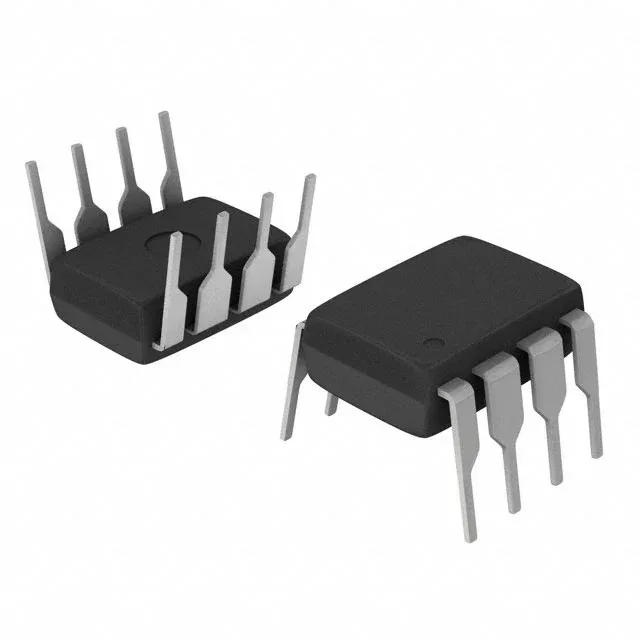
The STMicroelectronics M24C32-WBN6 is a 32Kbit serial EEPROM with an I2C interface, organized as 4K x 8 bits. It stores configuration parameters, calibration constants, and small data logs that must survive power loss. The 8-PDIP through-hole package is a natural fit for socketed prototyping, legacy board rework, or low-volume production runs where SMD reflow is not available.
450 ns access time and 1 MHz clock — timing margin on the I2C bus
The 450 ns access time is the read cycle window from the last clock edge to valid data on the SDA line. At the 1 MHz maximum clock frequency, that leaves roughly 550 ns of the 1 µs bit period for bus settle and hold — comfortable for most I2C masters, but check the input thresholds on the controller side if the bus has more than a few devices or long traces. The 5 ms page write time is the period the part is busy after a write command; the master must poll for the ACK polling sequence before sending the next command. For calibration tables or OTA staging areas under 4 KB, this is fine; for streaming large blocks, a page-write buffer strategy helps.
This covers outdoor telecom cabinets, factory floor controllers, and engine-bay-adjacent electronics where the part is not directly on the block. The 2.5V to 5.5V supply holds regulation across the full temperature band, so the write cycle time and data retention specs stay within the datasheet limits. For applications that see sustained junction temperatures above 85°C, a higher-temperature-grade EEPROM should be selected.
Obsolete — sourcing reality and the pin-compatible replacement path
The M24C32-WBN6 is listed as obsolete. STMicroelectronics has discontinued this through-hole variant. For new designs or volume production, the pin-compatible M24C32-WMN6 (SOIC-8 surface-mount package) is the direct functional equivalent — same 32Kbit I2C EEPROM core, same 2.5V to 5.5V supply, same 1 MHz clock, same 450 ns access time. The WMN6 uses an SOIC-8 footprint, so a board layout change is required.