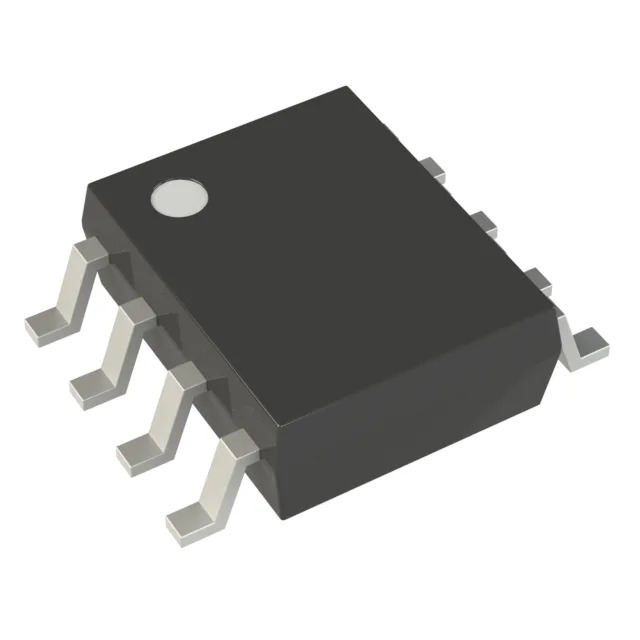
STMicroelectronics M24C32-RMN6TP — Memory (DRAM / SRAM / Flash / EEPROM)

STMicroelectronics M24C32-RMN6TP 32Kbit I2C EEPROM, 450ns

MPNM24C32-RMN6TP
Active

STMicroelectronics M24C32-RMN6TP, 32Kbit I2C EEPROM, 1 MHz clock, 450 ns access time, 1.8V-5.5V supply, 8-SOIC package, -40°C to 85°C industrial temperature.

$0.2600Ref. price · indicative, final on quote
Packaging8-SOIC (0.154", 3.90mm Width)
RoHSROHS3 Compliant
Independent supplier — new & surplus stockAuthenticity-screened · ESD-safe packingListing updated Aug 2026

Specifications

M24C32-RMN6TP specifications
ParameterValue
Memory typeNon-Volatile
MountingSurface Mount
Supply voltage1.8V ~ 5.5V
Clock frequency1 MHz
Memory interfaceI²C
Operating temperature-40°C ~ 85°C (TA)
PackageTape & Reel (TR) Cut Tape (CT)
TechnologyEEPROM
Access time450 ns
Memory size32Kbit
Memory formatEEPROM
Case8-SOIC (0.154\", 3.90mm Width)
Memory organization4K x 8
Write cycle time - word, page5ms

Product details

32Kbit I2C EEPROM — parameter storage for industrial and mixed-voltage designs

The STMicroelectronics M24C32-RMN6TP is a 32Kbit serial EEPROM with an I²C interface, organized as 4K x 8 bits. It stores configuration data, calibration constants, serial numbers, and boot parameters in systems that need non-volatile retention without battery backup. The 1 MHz clock rate supports fast-mode plus I²C bus operation, and the 450 ns access time defines the random-read latency from the memory array to the serial output register — fast enough for most parameter-fetch sequences without stalling the host controller.

The 450 ns access time is the random-read latency from the address latch to the first data bit appearing on the serial output. At a 1 MHz I²C clock (1 µs period), this latency consumes less than half a clock cycle — the bus master does not need to insert wait states or stretch the clock for read operations. For sequential reads, the access time only applies to the first byte; subsequent bytes stream at the full 1 MHz rate. This matters most when the host reads a calibration table or boot vector at power-up, where every microsecond of latency adds to system start time.

Active lifecycle — no end-of-life tracking required

ROHS3 compliance is confirmed, covering the full set of RoHS exemptions including lead-free soldering compatibility. No special handling or legacy solder-profile adjustments are needed for reflow assembly.

5 ms write cycle — plan for page writes

The write cycle time is 5 ms for a page write (up to 16 bytes per page). Writing the full 32Kbit array one byte at a time would take over 20 seconds; using 16-byte page writes reduces that to roughly 1.3 seconds. For production programming, the firmware loader or test fixture should use page writes to keep programming time acceptable. The part does not support a write-in-progress status pin — the host must poll the I²C acknowledge after each write cycle to know when the next write can start.

Frequently asked questions

Is M24C32-RMN6TP compatible with 3.3V?

Yes, 3.3V falls within the 1.8V to 5.5V supply range. The I²C bus thresholds scale with Vcc — at 3.3V the input low threshold is 0.3 x Vcc (0.99V) and input high threshold is 0.7 x Vcc (2.31V), compatible with 3.3V logic outputs.

What is the I2C address of M24C32?

The M24C32 uses a 7-bit I²C device address. The upper four bits are fixed at 1010b for the M24C32 family. The next three bits are set by the external address pins on the package — the M24C32-RMN6TP in 8-SOIC has pins for A0, A1, and A2, allowing up to eight devices on the same bus with unique addresses.

What is the closest functional equivalent to M24C32-RMN6TP?

The M24C32-FDW6TP is the closest functional equivalent within the same M24C32 family — same 32Kbit density, same 450 ns access time, same 1 MHz I²C interface, same 4K x 8 organization, and same 5 ms write cycle. The primary difference is the package: the FDW6TP uses a smaller 8-TSSOP footprint (4.4 mm body width) versus the 8-SOIC (3.90 mm body width) of the RMN6TP. The FDW6TP also has a slightly lower minimum supply voltage of 1.7V versus 1.8V. For a board designed for the 8-SOIC footprint, the RMN6TP is the correct package variant.