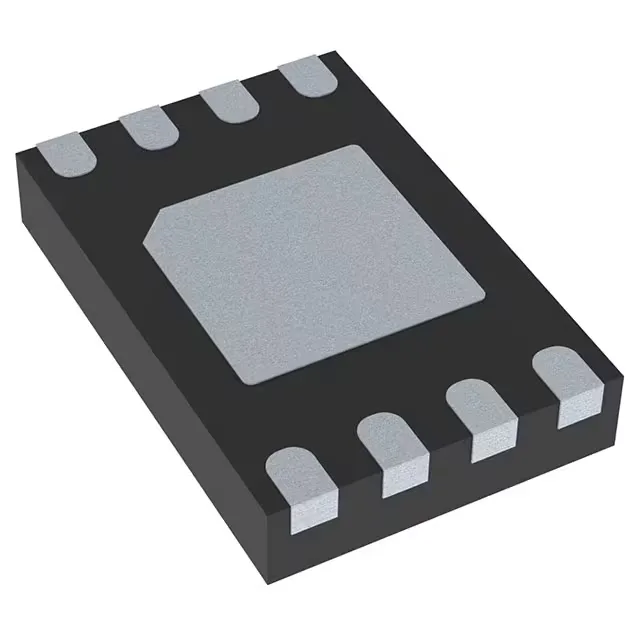
32 Kbit I²C EEPROM for configuration and calibration storage
The STMicroelectronics M24C32-FMC6TG is a 32 Kbit serial EEPROM with an I²C interface, organized as 4K x 8 bits. The 1 MHz clock rate matches standard I²C fast-mode, and the 450 ns access time is the read-cycle window the bus master must respect. Typical uses include storing calibration coefficients, device configuration, serial numbers, and firmware lookup tables in industrial sensors, telecom modules, and portable instrumentation.
Supply voltage range — 1.7V to 5.5V
The wide supply range covers 1.8V nominal (down to 1.7V minimum) through 5V systems. For a mixed-voltage design — say a 3.3V MCU talking to a 5V legacy sensor — this EEPROM sits on either rail without extra translation. The 1.8V compatibility is a common check: the part operates down to 1.7V, so it works on a 1.8V bus with margin.
Package — 8-UFDFN exposed pad
The 8-UFDFN exposed-pad package (2x3 mm body) saves board area but demands attention on the solder-paste stencil. The exposed pad needs a good thermal and electrical connection to the ground plane — without it the part can lift during reflow or run hot during write cycles. The 8-pin footprint is standard for this class, but the pad pitch is tight; a 0.5 mm stencil aperture is typical.
Industrial temperature range covers most outdoor, factory-floor, and automotive-cabin environments. Not rated for under-hood or downhole use (125°C), but fine for telecom cabinets, HVAC controllers, and portable gear that sees cold starts.
For new designs this is a safe pick; no near-term obsolescence risk. The base product number is M24C32, and the -FMC6TG suffix denotes the 8-UFDFN package and tape-and-reel shipping.
Write cycle time — 5 ms
If the application writes frequently — say logging data every few seconds — the 5 ms busy period blocks I²C access. For calibration constants written once at power-up, it is invisible. The page write mode lets you load up to 16 bytes in one cycle, reducing total write time for multi-byte updates.