Fixed 3.3V rail at 150 mA — the board-level fit
The LK112M33TR is a single-output positive linear regulator delivering a fixed 3.3 V at up to 150 mA from a maximum input of 14 V. That 3.3 V rail is the common digital core or I/O supply for a wide range of MCUs, sensors, and interface ICs — the 150 mA ceiling covers a small Cortex-M0 system or a single MEMS sensor plus its buffer, but not a multi-rail FPGA bank.
PSRR at 400 Hz — what the 55 dB means for the downstream noise budget
PSRR is specified at 55 dB at 400 Hz — that is the rejection ratio for ripple on the input rail at that frequency. A 100 mVpp ripple at 400 Hz on the input appears as roughly 0.18 mVpp on the output. The dropout voltage is 0.35 V max at the full 150 mA load — the input rail must stay above 3.65 V across the load range to keep the output in regulation. A 5 V rail with 5% tolerance (4.75 V min) provides 1.1 V of headroom, well clear of dropout.
Quiescent current and enable — battery-life implications
Quiescent current is 250 µA typical — the regulator's own draw when delivering load.
Temperature range and protection — where it survives
The operating junction temperature range is -30°C to 125°C, covering industrial and most automotive under-hood ambient conditions. Integrated overcurrent and overtemperature protection means the part will current-limit or thermally shut down before damaging itself under a sustained fault — useful for a supply rail that might see a momentary short during board assembly or in the field.
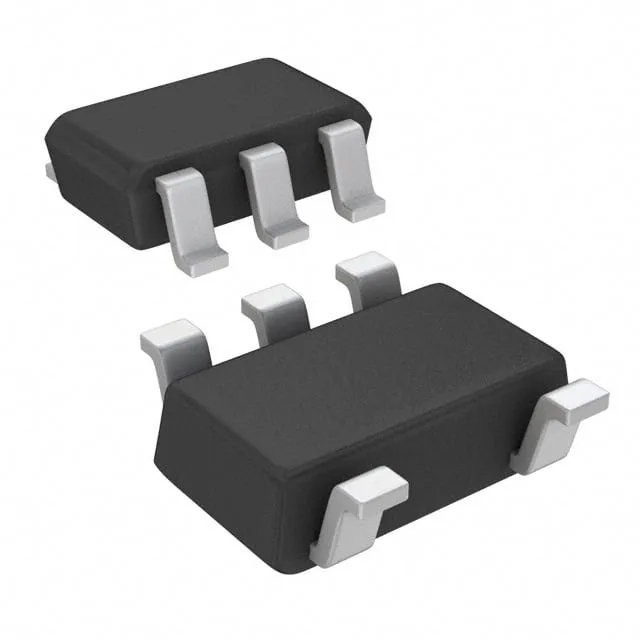
SOT-23-5 package — footprint and rework context
It is a common, low-cost, manually solderable footprint that fits on a two-layer board without micro-vias. The enable pin is on pin 3; the typical application circuit requires two small ceramic bypass caps on the input and output.