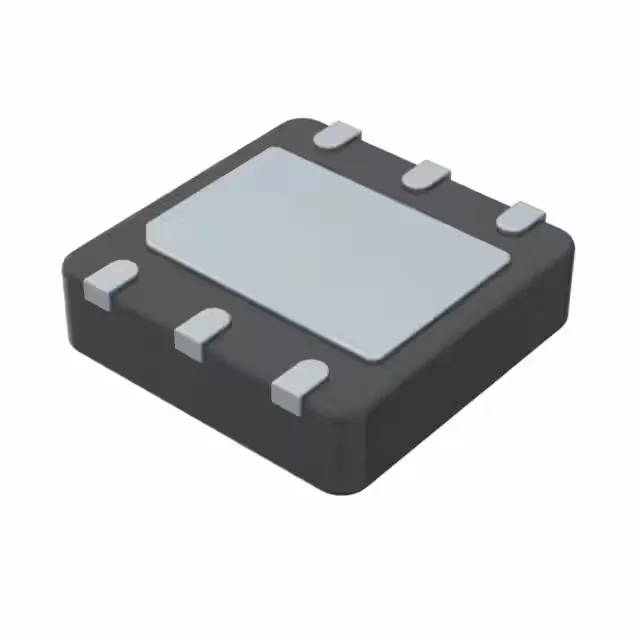
The LDFPVR delivers 62 dB of power-supply rejection at 120 Hz, rolling to 55 dB at 100 kHz. That 7 dB droop across nearly three decades means the regulator attenuates rectified mains ripple by a factor of ~1250× at the fundamental, and still knocks down switching-regulator noise by ~560× at 100 kHz — enough to keep a 16-bit ADC's reference rail clean without a post-filter LC stage.
1 A output, 0.5 V dropout — headroom budget for the rail
Rated 1 A continuous with a maximum dropout of 0.5 V at full load. That 0.5 V is the floor between input and output; below it the pass element enters the linear region and the output falls out of regulation. For a 3.3 V output rail, the input must stay above 3.8 V across the full load range — a 5 V bus with a Schottky diode drop still clears it. The 800 µA quiescent current is the regulator's own draw, not the load; in a battery-powered sensor that sleeps most of the time, that Iq is the dominant standing power drain.
0.8 V to 12 V adjustable from a 16 V max input
Output is adjustable from a 0.8 V reference up to 12 V, fed from a maximum 16 V input rail. The Enable and Power Good control pins let a supervisor sequence the rail: PG asserts when the output reaches ~92% of its nominal value, which can gate a downstream load or reset.
That is the industrial/automotive band — an engine-bay ECU or a rooftop solar microinverter that sees 105°C ambient still has 20°C of margin before the thermal shutdown (part of the Over Temperature protection) engages.
Active lifecycle — no LTB clock ticking
The protection feature set (Over Current, Over Temperature, Under Voltage Lockout) covers the common fault modes without requiring an external supervisor IC.