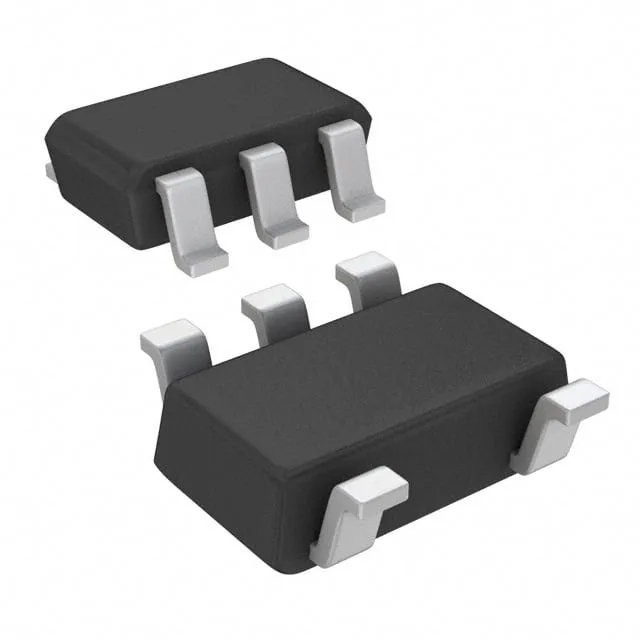
50 mA LDO with 3.3 V fixed rail and 0.225 V dropout
The LD2980ABM33TR is a 50 mA, 3.3 V fixed-output LDO from STMicroelectronics' LD2980 series. Its 0.225 V maximum dropout at full load means the input rail needs to stay above 3.525 V to keep the output in regulation — a 3.6 V supply has just 75 mV of headroom at 50 mA, so a 3.3 V rail from a battery near end-of-life may drop out before the LDO does.
PSRR and quiescent current — what they mean for the rail
63 dB of PSRR at 1 kHz means the LDO attenuates upstream ripple by a factor of roughly 1400 at that frequency — a 100 mVpp switching ripple on the input becomes about 70 µVpp on the output. That holds for ripple near 1 kHz; above a few hundred kHz the rejection rolls off, so a switching converter running at 500 kHz needs a post-filter if the load is an analog front-end. Quiescent current is 150 µA typical — the LDO's own draw is low enough for always-on domains in battery gear, but not as aggressive as a 1 µA LDO. The Enable pin lets a microcontroller shut the regulator down, cutting Iq to near zero when the rail is unused.
Temperature range and protection — industrial and automotive duty
The 16 V maximum input gives margin on a nominal 12 V battery — a load-dump transient that hits 40 V would still exceed the abs-max, so an external TVS clamp is needed for automotive direct-battery connections. Built-in over-current and over-temperature protection prevent the regulator from self-destructing under a short or a high-temperature fault — the die shuts down until the condition clears, then auto-recovers.
Supplied in a 5-pin SOT-23-5 (SC-74A) package — the same footprint as the industry-standard SOT-23-5. The 0.95 mm pitch and 2.9 mm body length fit tight PCB layouts; the thermal pad is the die-attach paddle on the bottom, so the copper pour under the package sets the effective thermal resistance. Surface-mount assembly with standard reflow profiles.