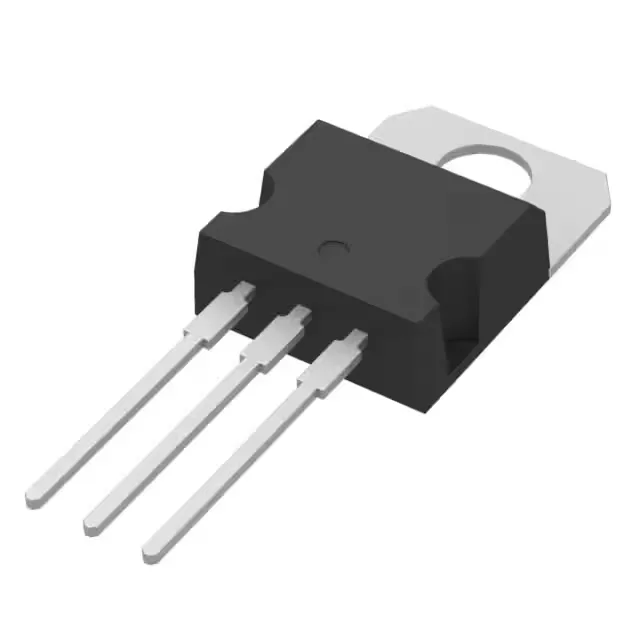
Fixed -12 V negative rail for bipolar supplies
The STMicroelectronics L7912CV is a fixed -12 V negative linear voltage regulator in a TO-220-3 through-hole package, rated for 1.5 A continuous output current. It is the complement to the positive 7812 series, forming the negative leg of a split-supply rail for op-amp circuits, audio preamps, industrial analog front-ends, and motor-drive control boards that need a clean -12 V bus. The fixed output eliminates external resistor dividers — just filter caps and a heatsink.
Dropout and input headroom
Typical dropout voltage is 1.1 V at 1 A output. That means the input rail needs to be at least -13.1 V (absolute minimum) to hold regulation at 1 A load — a -15 V supply rail gives comfortable margin. At full 1.5 A output, expect dropout to climb; the spec table lists 1.1 V as typical at 1 A, so budget a couple hundred millivolts more at the maximum current. The maximum input voltage is -35 V, so the part can handle unregulated rectified AC from a 24 V transformer secondary without a preregulator.
PSRR and ripple rejection
Power supply rejection ratio is 60 dB at 120 Hz — the standard rectifier ripple frequency. That translates to an attenuation factor of 1000: a 1 Vpp ripple on the input becomes about 1 mVpp on the output. For a -12 V rail feeding an audio op-amp or a precision ADC reference, this keeps hum out of the signal path. At higher frequencies PSRR rolls off, so a 10 µF to 100 µF output capacitor with low ESR helps maintain rejection above a few kilohertz.
Thermal management and heatsink
The TO-220-3 package has a metal tab that must be heatsinked for any load above about 500 mA. At 1.5 A output with a -15 V input, the regulator dissipates roughly 4.5 W — that requires a heatsink with thermal resistance around 20 °C/W or better to keep the junction under 125 °C. The part includes over-temperature and short-circuit protection, so it will survive a momentary overload, but sustained operation without a heatsink will trigger thermal shutdown. The tab is electrically connected to the output pin (-12 V), so an insulating pad and washer are needed if the heatsink is grounded.
It is ROHS3 compliant.