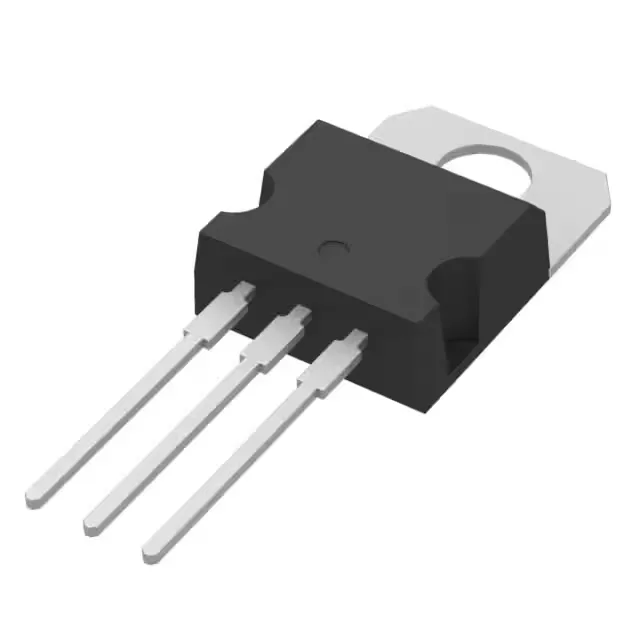
The L7905ACV is a fixed-output negative linear regulator delivering -5V at up to 1.5A from a negative input rail as low as -35V. It is the negative complement to the more common 78xx positive regulators — where a design needs a clean -5V supply for op-amp rails, RS-232 transceivers, or bipolar ADC references, this part fills that slot. The TO-220-3 package with its metal tab is designed to be bolted to a heatsink; without one, the 1.4V dropout at 1A (typical) multiplied by load current means the tab temperature climbs fast.
The 60 dB power-supply rejection ratio at 120 Hz is the figure that matters for rectified mains ripple. A full-wave bridge feeding a bulk capacitor leaves 100/120 Hz ripple on the unregulated DC bus; 60 dB attenuation knocks that ripple down by a factor of 1000. For a 1 Vpp ripple on the input, the output sees roughly 1 mVpp — adequate for most analog and logic loads. The PSRR rolls off above the line-frequency band, so high-frequency noise on the input rail needs a separate LC filter or post-regulator stage.
1.5 A output current — thermal budget at the tab
The 1.5 A output current rating is the maximum at the device level, but the real limit is thermal. With a 1.4 V dropout at 1 A, the power dissipated is 1.4 W before the load draws any current. In a 25°C ambient with no heatsink, the junction-to-ambient thermal resistance of a TO-220 (~65°C/W) means the die temperature hits 125°C at roughly 1.5 W — so at 1 A output the margin is tight. A heatsink with 10-15°C/W thermal resistance is typical for continuous 1 A operation. The built-in over-temperature and short-circuit protection prevent catastrophic failure if the load faults, but the protection threshold is a thermal shutdown, not a current foldback — the part cycles on and off until the fault clears.
The through-hole TO-220 package also means it is straightforward to hand-assemble or rework in prototype runs.
Commercial temperature grade — indoor and bench use
The lower bound at 0°C means the part is not rated for cold-start conditions below freezing — outdoor telecom cabinets, unheated enclosures, or automotive under-hood environments are outside its specified range. For indoor power supplies, bench instruments, and controlled-temperature industrial racks, the 125°C upper limit with proper heatsinking is adequate.